
 A Oneindia Venture


 Click it and Unblock the Notifications
Sandur Laminates Ltd. कंपली की लेखा नीति
Mar 31, 2010
1. The Company has been declared a sick company by the Board for
Industrial and Financial Reconstruction (BIFR); the Board vide its
order dated 12.06.2003 confirmed that the Company is not likely to make
its net worth exceed its accumulated losses within a reasonable time
while meeting all its financial obligations and that the Company as a
result thereof is not likely to become viable in future and hence it is
just, equitable and in public interest that it should be wound up under
Section 20(1) of the Sick Industrial Companies (Special Provisions)
Act, 1985. Subsequently, during the year 2005-06, the Company entered
into negotiated settlements with the financial institutions and a bank.
The Company also filed compromise petitions along with the financial
institutions and a bank before the Debt Recovery Tribunal. The Company
had entered into a Memorandum of Understanding with a strategic partner
according to which the said strategic partner had fully settled the
dues to the financial institutions and a bank. The High Court of
Kamataka, to which reference was made by the BIFR for winding up of the
Company, has since referred the matter back to the BIFR for arriving at
a rehabilitation package for revival of the Company. The Company had
submitted a rehabilitation proposal to the Operating Agency (OA), IDBI.
The Honle Bench of the BIFR at its hearing held on 14 May 2007 has
directed IDBI to submit the Draft Rehabilitation Scheme along with its
report. The Company has entered into one time settlement for payment of
dues to certain companies. However, the Company has not written back
the dues representing the wavier agreed by the said companies pending
approval of Draft Rehabilitation Scheme by the BIFR. The Company has
submitted the revised rehabilitation proposal to IDBI, which inturn
submitted a revised Draft Rehabilitation Scheme to BIFR on 28 August
2009 for its consideration. In view of the above developments, the
accounts have been prepared on a going concern basis.
2. Accounting Policies
The financial statements are prepared in accordance with Generally
Accepted Accounting Principles under the historical cost convention
on an accrual basis and in accordance with the requirements of the
Companies Act, 1956. The significant accounting policies followed by
the Company are as stated below:
i) Use of estimates:
The Company uses prudent and reasonable assumptions and estimates in
the preparation of its financial statements, and these are reflected in
the reported amounts of income and expenses during the year, and the
reported balances of assets and liabilities, and disclosures relating
to contingent liabilities, as at the date of the financial statements.
ii) Fixed Assets
Fixed assets are capitalised at acquisition cost including directly
attributable costs of bringing the asset to its working condition for
the intended use.
iii) Depreciation /Amortization
The Companys policy is to depreciate its assets on a straight line
method at the rates and in the manner prescribed in Schedule XIV to the
Companies Act, 1956 except technical know-how fee which is amortized
over six years in equal annual instalments from the date of
commencement of commercial production.
Individual assets costing less than Rs. 5,000/- are depreciated in full
in the year of its purchase.
iv) Foreign Currency Transactions
Transactions in foreign currencies are recorded at exchange rates
prevailing on the respective dates of the relevant transactions.
Foreign exchange rate fluctuations relating to monetary assets and
liabilities are restated at the year end rates.
The net loss or gain arising on restatement/ settlement, if any, is
adjusted to the profit and loss account.
v) Investments
Investments are valued at acquisition cost. However, provision for
diminution in value is made to recognise a decline, other than
temporary, in value of long-term investments.
vi) Revenue recognition
Revenue is recognised at the point of despatch of materials to
customers from plant or stock points, as applicable.
vii) Provisions and Contingencies:
A provision is recognized when the Company has a present obligation as
a result of past events and it is probable that an outflow of resources
will be required to settle the obligation, in respect of which a
reliable estimate can be made. Provisions are not discounted to present
value and are determined based on best estimate required to settle the
obligation at the Balance Sheet date. These are reviewed at each
Balance Sheet date and adjusted to reflect the current best estimates.
Contingent Liabilities are not recognized but are disclosed in the
notes to accounts.
Contingent Assets are neither recognized nor disclosed in the financial
statements.
viii) Impairment of Assets
An impairment loss is recognised when the carrying amount of an asset
exceeds greater of net selling price or value in use. ix) Taxation
a) Current Tax
Current tax expense is determined in accordance with the provisions of
the Income-tax Act, 1961.
b) Deferred Tax
Deferred tax assets and liabilities are measured using the tax rates
which have been enacted or substantively enacted at the balance sheet
date. Deferred tax expense or benefit is recognised, subject to
consideration of prudence, on timing differences being the difference
between taxable income and accounting income that originate in one
period and are capable of reversing in one or more subsequent periods.
Deferred tax assets are recognised for all deductible timing
differences and are carried forward to the extent there is reasonable
certainty that sufficient taxable profit will be available to release
these assets. Deferred tax assets to the extent that relate to brought
forward losses and unabsorbed depreciation, are recognised only to the
extent there is virtual certainty of realisation, that sufficient
taxable income will be available to realise such asset.
Disclaimer: This is 3rd Party content/feed, viewers are requested to use their discretion and conduct proper diligence before investing, GoodReturns does not take any liability on the genuineness and correctness of the information in this article
Sandur Laminates Ltd. पर और जानकारी
-
Sandur Laminates Ltd. कंपनी का विवरण
- कंपनी का प्रोफाइल
- कंपनी का इतिहास
- मैनेजमेंट टीम
- पूंजी ढांचा
- बैंकर/ऑडीटर/रजिस्ट्रार
-
Sandur Laminates Ltd. मुख्य वित्तीय अनुपात
- अनुपात
-
Sandur Laminates Ltd. परिणाम
- छहमाही परिणाम
- वार्षिक परिणाम
-
Sandur Laminates Ltd. Financial Data
- ऑडिट के परिणाम
- नकदी प्रवाह
- बैलेंस शीट
-
Sandur Laminates Ltd. की रिपोर्ट
- लेखा नीति
- ऑडीटर की रिपोर्ट
- निदेशक की रिपोर्ट
- खाते के लिये नोट
-
Sandur Laminates Ltd. कॉर्पोरेट घोषणाएं
- लाभांश
- बोर्ड की मीटिंग
-
 Share Market की तेज़ी बुरा फंसाएगी, बाज़ार में इन Stocks से बना लो दूरी!
 -
 Share Market में जोरदार तेजी, निफ्टी 24,200 के पार; सबसे अधिक किस शेयर में तेजी?
 -
 Trump Warning से Iran-US तनाव बढ़ा, Crude Oil में हलचल: Share Market Panic में क्या करें?
 -
 Share Market: कल की भारी गिरावट के बाद बाजार में लौटी तेजी, Sensex और Nifty में बढ़त के साथ कारोबार; आगे क्या
 -
 South Korea Market Crash: टेक शेयरों की बिकवाली से मचा हड़कंप! Bear Market में क्यों पहुंचा KOSPI?
 -
 Stock Market: शेयर बाजार में आज क्यों आई गिरावट? अमेरिका-ईरान तनाव के अलावा क्या है गिरावट की सबसे बड़ी वजहें
 -
 Sensex Outlook: सेंसेक्स 1 लाख तक पहुंचेगा या 66,000 तक गिरेगा? मॉर्गन स्टेनली ने बताए तीन बड़े अनुमान
 -
 Kalyan Jewellers Share Crash: अच्छे बिजनेस अपडेट के बावजूद 8% क्यों टूटा शेयर? जानिए पूरी वजह
 -
 Stock Market: अचानक क्यों टूटा बाज़ार? Sensex 350 प्वाइंट तो Nifty 24,450 के नीचे! जानिए 4 बड़ी वजहें
 -
 Stock Market Today: सप्ताह के पहले दिन शेयर बाजार में तेजी! आज शेयर बाजार में किसका रहा जलवा?
 -
 Stock Market में आएगा बड़ा ब्रेकआउट? 2026 के 5 सबसे दमदार सेक्टर्स!
 -
 HCL Tech Share Price: AI Deal के दम पर शेयर में 7% की तेजी, क्या आगे भी बढ़ेगा?
 -
 Share Market Today: सेंसेक्स 650 अंक उछला, निवेशकों की दौलत ₹2.43 लाख करोड़ बढ़ी, जानें तेजी की वजह
 -
 Nifty IT में 4% की तूफानी रैली! Infosys, TCS, Wipro में खरीदारी का मौका?
 -
 Vedanta Demerger के बाद धमाका: Oil & Gas में 20% की तेजी, निवेशकों की हुई चांदी
 -
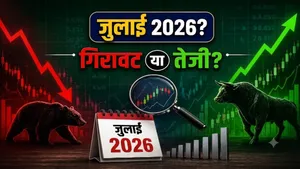 Nifty Outlook: क्या खत्म होगी गिरावट? 10 साल का Data क्या कहता है, जानें आगे की चाल
-
Block for 8 hours
-
Block for 12 hours
-
Block for 24 hours
-
Don't block

 Sign in with Google
- Male
- Female
- Others
- Under 18
- 18 to 25
- 26 to 35
- 36 to 45
- 45 to 55
- 55+