
 A Oneindia Venture


 Click it and Unblock the Notifications
Escorp Asset Management Ltd. के अकाउंट के लिये नोट
Mar 31, 2025
15 Provisions, Contingent Liabilities and Contingent Assets:
A provision is recognised if, as a result of a past event, the group has a present legal or constructive obligation that can be estimated reliably, and it is probable that an outflow of economic benefits will be
required to settle the obligation. ''
Provisions for onerous contracts are recognized when the expected benefits to be derived by the Company from a contract are lower than the unavoidable costs of meeting the future obligations under the
contract.
A disclosure for contingent liabilities is made where there is a possible obligation or a present obligation that may probably not require an outflow of resources or an obligation for which the future outcome
cannot be ascertained with reasonable certainty. When there is a possible or a present obligation where the likelihood of outflow of resources is remote, no provision or disclosure is made.
Contingent assets are neither recognized nor disclosed in financial statements.
Reason for shortfall
The Company has made an excess expenditure under its CSR policy to the extent of Rs. 0.02 lakhs as on 31st March
2025.
Nature of CSR activities
During the year, the Company has incurred a sum of Rs. 18.50 Lakhs towards CSR expenditure as per policy laid down
pursuant to the provisions of Companies Act, 2013 and rules framed thereunder. The Company under its CSR policy,
affirms its commitment of seamless integration of marketplace, workplace, environment and community concerns with
business operations by undertaking activities / initiatives that are not taken in its normal course of business and/or
confined to only the employees and their relatives and which are in line with the broad-based list of activities, areas or
subjects that are set out under schedule VII of the Companies Act, 2013.
24 Segment Reporting
The Company''s Board of Directors have been identified as the Chief Operating Decision Maker (CODM) as defined
under Ind AS 108 "Operating Segments". The CODM evaluates the Company''s performance and allocated the resources
based on an analysis of various performance indicators . The Company is primarily engaged in the business of financial
services mainly Portfolio Management Services (PMS) and dealing with Synergical investments. The same has been
considered as business segment and the management considers these as a single reportable segment. Accordingly,
disclosure of segment information has not been furnished.
27 Financial instruments
The fair values of the financial assets and liabilities are included at the amount at which the instrument could be
exchanged in a current transaction between willing parties, other than in a forced or liquidation sale.
The following methods and assumptions were used to estimate the fair values:
1. Fair value of cash and short-term deposits, trade and other short term receivables, trade payables, other current
liabilities, short term loans from banks and other financial institutions approximate their carrying amounts largely due
to short term maturities of these instruments.
2. Financial instruments with fixed and variable interest rates are evaluated by the Company based on parameters
such as interest rates and individual credit worthiness of the counterparty. Based on this evaluation, allowances are
taken to account for expected losses of these receivables. Accordingly, fair value of such instruments is not materially
different from their carrying amounts.
The Company uses the following hierarchy for determining and disclosing the fair value of financial
instruments by valuation technique:
Level 1: Quoted (unadjusted) prices in active markets for identical assets or liabilities.
Level 2: Other techniques for which all inputs which have a significant effect on the fair value are observable, either
directly or indirectly.
Level 3: Techniques which use inputs that have a significant effect on the recorded fair value that are not based on
observable market data.
27 Financial instruments
Fair value estimation
For financial instruments measured at fair value in the Balance Sheet, a three level fair value hierarchy is used that
reflects the significance of inputs used in the measurements. The hierarchy gives the highest priority to unadjusted
quoted prices in active markets for identical assets or liabilities (Level 1 measurements) and lowest priority to
unobservable inputs (Level 3 measurements).
The categories used are as follows:
⢠Level 1: quoted prices for identical instruments
⢠Level 2: directly or indirectly observable market inputs, other than Level 1 inputs; and
⢠Level 3: inputs which are not based on observable market data.
For assets and liabilities which are carried at fair value, the classification of fair value calculations by category is
summarised below:
28 Financial risk factors
The Company''s principal financial liabilities comprise loans and borrowings, advances and trade and other payables. The purpose of these
financial liabilities is to finance the Companyâs operations and to provide to support its operations. The Companyâs principal financial assets
include Investments (Strategic and Non Strategic), loans, trade and other receivables, and cash and cash equivalents that derive directly from its
operations.
The Company''s activities exposes it to Liquidity Risk, Market Risk and Credit risk. The Board of Directors reviews and agrees policies for
managing each of these risks, which are summarised as below.
(a) Liquidity risk
The risk that an entity will encounter difficulty in meeting obligations associated with financial liabilities that are settled by delivering cash or
another financial asset. Liquidity risk management implies maintenance sufficient cash including availability of funding through an adequate
amount of committed credit facilities to meet the obligations as and when due.
The Company manages its liquidity risk by ensuring as far as possible that it will have sufficient liquidity to meet its short term and long term
liabilities as and when due. Anticipated future cash flows are expected to be sufficient to meet the liquidity requirements of the Company. The
Company does not have any undrawn borrowing facilities with the Banks/ Financial institutions.
(b) Market risk
Market risk is the risk that the fair value of future cash flows of a financial instrument will fluctuate because of changes in market prices. Market
risk comprises three types of risk: interest rate risk, currency risk and other price risk, such as equity price risk and commodity risk. Financial
instruments affected by market risk includes investment, deposits, foreign currency receivables and payables. The Company''s Management and
related team manages the Market risk, which evaluates and exercises independent control over the entire process of market risk management.
(i) Foreign currency risk
Foreign currency risk can only arise on financial instruments that are denominated in a currency other than the functional currency in which they
are measured. The Company''s functional and presentation currency is INR. The Company does not have any foreign currency transactions and
hence is not exposed to the Foreign Currency Risks.
(ii) Interest rate risk
Interest rate risk is the risk that the fair value of future cash flows of the financial instruments will fluctuate because of changes in market interest
rates. The Company does not have any long term borrowings. Hence, the Company is not exposed to the interest rate risk.
28 Financial risk factors
(ii) Price Risk *
The Companyâs exposure to equity securities price risk arises from investments held by the Company and classified in the balance sheet either at
fair value through OCI or at fair value through profit and loss. To manage its price risk arising from investments in equity securities, the Company
offsets its risk through strong research policies practice followed.
Sensitivity
The table below summarizes the impact of increases/(decreases) of the BSE index on the Companyâs equity and Gain/ (Loss) for the period. The
analysis is based on the assumption that the index has increased by 5 % or decreased by 5 % with all other variables held constant, and that all the
Companyâs equity instruments moved in line with the index .
(c) Credit risk
Credit risk is the risk of financial loss to the Company if a customer or counter-party fails to meet its contractual obligations. The Company is
exposed to credit risks from its operating activities, primarily trade receivables, cash and cash equivalents, deposits with banks and other financial
instruments.
The Company considers the probability of default upon initial recognition of assets and whether there has been a significant increase in credit
risks on an ongoing basis throughout each reporting period.
To assess whether there is a significant increase in credit risk the Company compares the risks of default occurring on the assets as at the
reporting date with the risk of default as at the date of initial recognition. It considers the reasonable and supportive forward looking information
such as:
(i) Actual or expected significant adverse changes in business.
(ii) Actual or expected significant changes in the operating results of the counterparty.
(iii) Financial or economic conditions that are expected to cause a significant change to the counterparty''s ability to meet its obligations
ESCORP ASSET MANAGEMENT LIMITED
CIN: L17121MH2011PLC213451
Notes to financial statements for the year ended 31st March, 2025
29 The Company did not have any long- term contracts including derivative contracts for which there were any material foreseeable losses.
30 The Company has complied with number of layers of subsidiaries as prescribed under Section 186(1) of the Companies Act read with Companies
(Restriction on number of layers) Rules, 2017.
31 The company does not have transactions with the companies struck off under section 248 of Companies Act ,2013.
32 The Company does not have any Benami property, where any proceeding has been initiated or pending against the Company for holding any Benami
properly.
33 The Company does not have any charges or satisfaction which is yet to be registered with ROC beyond the statutory period.
34 The Company has not been declared wilful defaulter by any bank or financial institution or government or any government authority.
35 The Company has not any such transaction which is not recorded in the books of accounts that has been surrendered or disclosed as income during the
year in the tax assessments under die Income Tax Act, 1961 (such as, search or survey or any other relevant provisions of the In come Tax Act, 1961).
36 There has been no delay in transferring amounts, required to be transferred, to the Investor Education and Protection Fund by the Company.
37 The financial statements were approved for issue by the Board of Directors on 29th April 2025.
38 The figures of the previous year''s have been regrouped or reclassified wherever necessary'' to make them comparable.
39 Figures have been rounded off to the nearest lacs of rupees.
Material Accounting Policy
The accompanying notes are an integral part of the financial statements
For V, N, Purohit & Co, For and on behalf of the
Chartered Accountants Escorp Asset Management Limited
Firm Regn No. 304040E
Sd/- Sd/-
O P Pareek Shripal Shah Shreyas Shah
Partner Director & CFO Director
Membership No. 014238 DIN: 01628855 DIN: 01835575
UDIN: 25014238BMJMAP6398
Place : New Delhi Place ; Mumbai Place : Mumbai
Date : 29th April 2025 Date : 29th April, 2025 Date : 29th April, 2025
Sd/-
Bhoomi Shah
Company Secretary
PAN: IFPPS0048L
Place; Mumbai
Date : 29th April, 2025
Mar 31, 2024
15 Provisions, Contingent Liabilities and Contingent Assets:
A provision is recognised if, as a result of a past event, the group has a present legal or constructive obligation that can be estimated reliably, and it is probable that an outflow of economic benefits will be required to settle the obligation.
Provisions for onerous contracts are recognized when the expected benefits to be derived by the Company from a contract are lower than the unavoidable costs ofmeeting the future obligations under the contract.
A disclosure for contingent liabilities is made where there is a possible obligation or a present obligation that may probably not require an outflow ofresources or an obligation for which the future outcome cannot be ascertained with reasonable certainty. When there is a possible or a present obligation where the likelihood of outflow of resources is remote, no provision or disclosure is made.
Contingent assets are neither recognized nor disclosed in financial statements.
26 Financial instruments
The fair values of the financial assets and liabilities are included at the amount at which the instrument could be exchanged in a current transaction between willing parties, other than in a forced or liquidation sale.
The following methods and assumptions were used to estimate the fair values:
1. Fair value of cash and short-term deposits, trade and other short term receivables, trade payables, other current liabilities, short term loans from banks and other financial institutions approximate their carrying amounts largely due to short term maturities of these instruments.
2. Financial instruments with fixed and variable interest rates are evaluated by the Company based on parameters such as interest rates and individual credit worthiness of the counterparty. Based on this evaluation, allowances are taken to account for expected losses of these receivables. Accordingly, fair value of such instruments is not materially different from their carrying amounts.
The Company uses the following hierarchy for determining and disclosing the fair value of financial instruments by valuation technique:
Level 1: Quoted (unadjusted) prices in active markets for identical assets or liabilities.
Level 2: Other techniques for which all inputs which have a significant effect on the fair value are observable, either directly or indirectly.
Level 3: Techniques which use inputs that have a significant effect on the recorded fair value that are not based on observable market data.
Fair value estimation
For financial instruments measured at fair value in the Balance Sheet, a three level fair value hierarchy is used that reflects the significance of inputs used in the measurements. The hierarchy gives the highest priority to unadjusted quoted prices in active markets for identical assets or liabilities (Level 1 measurements) and lowest priority to unobservable inputs (Level 3 measurements).
The categories used are as follows:
⢠Level 1: quoted prices for identical instruments
⢠Level 2: directly or indirectly observable market inputs, other than Level 1 inputs; and
⢠Level 3: inputs which are not based on observable market data.
For assets and liabilities which are carried at fair value, the classification of fair value calculations by category is
27 Financial risk factors
The Company''s principal financial liabilities comprise loans and borrowings, advances and trade and other payables. The purpose of these financial liabilities is to finance the Companyâs operations and to provide to support its operations. The Companyâs principal financial assets include Investments (Strategic and Non Strategic), loans, trade and other receivables, and cash and cash equivalents that derive directly from its operations.
The Company''s activities exposes it to Liquidity Risk, Market Risk and Credit risk. The Board ofDirectors reviews and agrees policies for managing each of these risks, which are summarised as below.
(a) Liquidity risk
The risk that an entity will encounter difficulty in meeting obligations associated with financial liabilities that are settled by delivering cash or another financial asset. Liquidity risk management implies maintenance sufficient cash including availability of funding through an adequate amount ofcommitted credit facilities to meet the obligations as and when due.
The Company manages its liquidity risk by ensuring as far as possible that it will have sufficient liquidity to meet its short tem and long term liabilities as and when due. Anticipated future cash flows are expected to be sufficient to meet the liquidity requirements of the Company. The Company does not have any undrawn borrowing facilities with the Banks/ Financial institutions.
(b) Market risk
Market risk is the risk that the fair value offuture cash flows ofa financial instrument will fluctuate because ofchanges in market prices. Market risk comprises three types ofrisk: interest rate risk, currency risk and other price risk, such as equity price risk and commodity risk. Financial instruments affected by market risk includes investment, deposits, foreign currency receivables and payables. The Company''s Management and related team manages the Market risk, which evaluates and exercises independent control over the entire process of market risk management.
(i) Foreign currency risk
Foreign currency risk can only arise on financial instruments that are denominated in a currency other than the functional currency in which they are measured. The Company''s functional and presentation currency is INR. The Company does not have any foreign currency transactions and hence is not exposed to the Foreign Currency Risks.
(ii) Interest rate risk
Interest rate risk is the risk that the fair value of future cash flows of the financial instruments will fluctuate because of changes in market interest rates. The Company does not have any long term borrowings. Hence, the Company is not exposed to the interest rate risk.
(ii) Price Risk
The Companyâs exposure to equity securities price risk arises from investments held by the Company and classified in the balance sheet either at fair value through OCI or at fair value through profit and loss. To manage its price risk arising from investments in equity securities, the Company offsets its risk through strong research policies practice followed.
Sensitivity
The table below summarizes the impact of increases/(decreases) of the BSE index on the Companyâs equity and Gain/ (Loss) for the period. The analysis is based on the assumption that the index has increased by 5 % or decreased by 5 % with all other variables held constant, and that all the Companyâs equity instruments moved in line with the index .
(d) Capital risk management
The Companyâs objectives when managing capital are to :
(i) safeguard their ability to continue as a going concern, so that they can continue to provide returns for shareholders and benefits for other stakeholders, and
(ii) maintain an optimal capital structure to reduce the cost of capital
In order to maintain or adjust the capital structure, the Company may issue new shares, adjust the amount of dividends paid to shareholders etc. The Company''s policy is to maintain a stable and strong capital structure with a focus on total equity so as to maintain investor, creditors and market confidence and to sustain future development and growth of its business.
The Company will take appropriate steps in order to maintain, or if necessary adjust, its capital structure.
28 The Company did not have any long- term contracts including derivative contracts for which there were any material foreseeable losses.
29 The Company has complied with number of layers of subsidiaries as prescribed under Section 186(1) of the Companies Act read with Companies (Restriction on number of layers) Rules, 2017.
30 The company does not have transactions with the companies struck off under section 248 of Companies Act ,2013.
31 The Company does not have any Benami property, where any proceeding has been initiated or pending against the Company for holding any Benami property.
32 The Company does not have any charges or satisfaction which is yet to be registered with ROC beyond the statutory period.
33 The Company has not been declared wilful defaulter by any bank or financial institution or government or any government authority.
34 The Company has not any such transaction which is not recorded in the books of accounts that has been surrendered or disclosed as income during the year in the tax assessments under the Income Tax Act, 1961 (such as, search or survey or any other relevant provisions of the Income Tax Act, 1961).
35 There has been no delay in transferring amounts, required to be transferred, to the Investor Education and Protection Fund by the Company.
36 The financial statements were approved for issue by the Board of Directors on 23rd May, 2024
37 The figures of the previous year''s have been regrouped or reclassified wherever necessary to make them comparable.
38 Figures have been rounded off to the nearest lacs of rupees.
Material Accounting Policy 1C
As per our report of even date
For V. N. Purohit & Co. For and on behalf of the
Chartered Accountants Escorp Asset Management Limited
Firm Regn No. 304040E
Sd/- Sd/- Sd/-
O. P. Pareek Shripal Shah Shreyas Shah
Partner Director & CFO Director
Membership No. 014238 DIN: 01628855 DIN: 01835575
UDIN24014238BKAAUT4857 Place : Mumbai Place : Mumbai
Place : New Delhi Date : 23rd May, 2024 Date : 23rd May, 2024
Date : 23rd May, 2024
Sd/-
Reenal Khandelwal
Company Secretary ACS: 65348 Place : Mumbai Date : 23rd May, 2024
Mar 31, 2023
18. Provisions, Contingent Liabilities and Contingent Assets:
A provision is recognised if, as a result of a past event, the group has a present legal or constructive obligation that can be estimated reliably, and it is probable that an outflow of economic benefits will be required to settle the obligation.
Provisions for onerous contracts are recognized when the expected benefits to be derived by the Company from a contract are lower than the unavoidable costs of meeting the future obligations under the contract.
A disclosure for contingent liabilities is made where there is a possible obligation or a present obligation that may probably not require an outflow of resources or an obligation for which the future outcome cannot be ascertained with reasonable certainty. When there is a possible or a present obligation where the likelihood of outflow of resources is remote, no provision or disclosure is made.
Contingent assets are neither recognized nor disclosed in financial statements.
22 Contingent liabilities & Commitments
The company does not have any contingent liabilities and Commitements (including Capital Commitmemnts as on March 31, 2023 (As at March 31, 2022 - Nil).
25 Segment Reporting
The Company''s Board of Directors have been identified as the Chief Operating Decision Maker (CODM) as defined under Ind AS 108 "Operating Segments". The CODM evaluates the Company''s performance and allocated the resources based on an analysis of various performance indicators . The Company is primarily engaged in the business of financial services mainly Portfolio Management Services (PMS) and dealing with Synergical investments. The same has been considered as business segment and the management considers these as a single reportable segment. Accordingly, disclosure of segment information has not been furnished.
28 Financial instruments
The fair values of the financial assets and liabilities are included at the amount at which the instrument could be exchanged in a current transaction between willing parties, other than in a forced or liquidation sale.
The following methods and assumptions were used to estimate the fair values:
1. Fair value of cash and short-term deposits, trade and other short term receivables, trade payables, other current liabilities, short term loans from banks and other financial institutions approximate their carrying amounts largely due to short term maturities of these instruments.
2. Financial instruments with fixed and variable interest rates are evaluated by the Company based on parameters such as interest rates and individual credit worthiness of the counterparty. Based on this evaluation, allowances are taken to account for expected losses of these receivables. Accordingly, fair value of such instruments is not materially different from their carrying amounts.
The Company uses the following hierarchy for determining and disclosing the fair value of financial instruments by valuation technique:
Level 1: Quoted (unadjusted) prices in active markets for identical assets or liabilities.
Level 2: Other techniques for which all inputs which have a significant effect on the fair value are observable, either directly or indirectly.
Level 3: Techniques which use inputs that have a significant effect on the recorded fair value that are not based on observable market data.
28 Financial instruments Fair value estimation
For financial instruments measured at fair value in the Balance Sheet, a three level fair value hierarchy is used that reflects the significance of inputs used in the measurements. The hierarchy gives the highest priority to unadjusted quoted prices in active markets for identical assets or liabilities (Level 1 measurements) and lowest priority to unobservable inputs (Level 3 measurements).
The categories used are as follows:
⢠Level 1: quoted prices for identical instruments
⢠Level 2: directly or indirectly observable market inputs, other than Level 1 inputs; and
⢠Level 3: inputs which are not based on observable market data.
For assets and liabilities which are carried at fair value, the classification of fair value calculations by category is summarised below:
29 Financial risk factors
The Company''s principal financial liabilities comprise loans and borrowings, advances and trade and other payables. The purpose of these financial liabilities is to finance the Companyâs operations and to provide to support its operations. The Companyâs principal financial assets include Investments (Strategic and Non Strategic), loans, trade and other receivables, and cash and cash equivalents that derive directly from its operations.
The Company''s activities exposes it to Liquidity Risk, Market Risk and Credit risk. The Board of Directors reviews and agrees policies for managing each of these risks, which are summarised as below.
(a) Liquidity risk
The risk that an entity will encounter difficulty in meeting obligations associated with financial liabilities that are settled by delivering cash or another financial asset. Liquidity risk management implies maintenance sufficient cash including availability of funding through an adequate amount of committed credit facilities to meet the obligations as and when due.
The Company manages its liquidity risk by ensuring as far as possible that it will have sufficient liquidity to meet its short tem and long term liabilities as and when due. Anticipated future cash flows are expected to be sufficient to meet the liquidity requirements of the Company. The Company does not have any undrawn borrowing facilities with the Banks/ Financial institutions.
(b) Market risk
Market risk is the risk that the fair value of future cash flows of a financial instrument will fluctuate because of changes in market prices. Market risk comprises three types of risk: interest rate risk, currency risk and other price risk, such as equity price risk and commodity risk. Financial instruments affected by market risk includes investment, deposits, foreign currency receivables and payables. The Company''s Management and related team manages the Market risk, which evaluates and exercises independent control over the entire process of market risk management.
(i) Foreign currency risk
Foreign currency risk can only arise on financial instruments that are denominated in a currency other than the functional currency in which they are measured. The Company''s functional and presentation currency is INR. The Company does not have any foreign currency transactions and hence is not exposed to the Foreign Currency Risks.
(ii) Interest rate risk
Interest rate risk is the risk that the fair value of future cash flows of the financial instruments will fluctuate because of changes in market interest rates. The Company does not have any long term borrowings. Hence, the Company is not exposed to the interest rate risk.
29 Financial risk factors (ii) Price Risk
The Companyâs exposure to equity securities price risk arises from investments held by the Company and classified in the balance sheet either at fair value through OCI or at fair value through profit and loss. To manage its price risk arising from investments in equity securities, the Company offsets its risk through strong research policies practice followed.
Sensitivity
The table below summarizes the impact of increases/(decreases) of the BSE index on the Companyâs equity and Gain/ (Loss) for the period. The analysis is based on the assumption that the index has increased by5 % or decreased by5 % with all other variables held constant, and that all the Companyâs equity instruments moved in line with the index .
(c) Credit risk
Credit risk is the risk of financial loss to the Company if a customer or counter-party fails to meet its contractual obligations. The Company is exposed to credit risks from its operating activities, primarily trade receivables, cash and cash equivalents, deposits with banks and other financial instruments.
The Company is not significantly exposed to the credit risk toward trade receivables considering the nature of serivces provided by the Company.
30 Capital risk management
The Companyâs objectives when managing capital are to :
(i) safeguard their ability to continue as a going concern, so that they can continue to provide returns for shareholders and benefits for other stakeholders, and
(ii) maintain an optimal capital structure to reduce the cost of capital
In order to maintain or adjust the capital structure, the Company may issue new shares, adjust the amount of dividends paid to shareholders etc. The Company''s policy is to maintain a stable and strong capital structure with a focus on total equity so as to maintain investor, creditors and market confidence and to sustain future development and growth of its business.
The Company will take appropriate steps in order to maintain, or if necessary adjust, its capital structure.
31 There are no litigations pending by or against the Company.
32 Recent Accounting prouncements
Ind AS 12 ââIncome taxesâ - Appendix C â Uncertainty over income tax treatments
On March 30, 2019, Ministry of Corporate affairs have notified Appendix C to Ind AS 12, uncertainty over the income tax treatments which is to be applied while performing the determination of taxable profits/(loss), tax bases, unused tax losses, unused tax credits and tax rates, when there is uncertainty over income tax treatments under Ind AS 12. According to the appendix, the company needs to determine the probability of the relevant tax authorities accepting the each tax treatments that the companies have used or plan to use in their income tax filings which has to be considered to compute the most likely amount or expected value of the tax treatments, when determining the taxable profts/(loss), tax bases, unused tax losses, unused tax credits and tax rates. The Company is evaluating the impact of the issued appendix C on its financial statements/4
33 The Company does not have any Benami property, where any proceeding has been initiated or pending against the Company for holding any Benami property.
34 The Company does not have any charges or satisfaction which is yet to be registered with ROC beyond the statutory period.
35 The Company has not been declared wilful defaulter by any bank or financial institution or government or any government authority.
36 The Company has not any such transaction which is not recorded in the books of accounts that has been surrendered or disclosed as income during the year in the tax assessments under the Income Tax Act, 1961 (such as, search or survey or any other relevant provisions of the Income Tax Act, 1961).
37 The company does not have transactions with the companies struck off under section 248 of Companies Act ,2013.
38 There are no litigations pending by or against the Company.
39 The financial statements were approved for issue by the Board of Directors on 26th May 2023 .
40 The figures of the previous year''s have been regrouped or reclassified wherever necessary to make them comaprable.
41 Figures have been rounded off to the nearest lacs of rupees.
For V N PUROHIT & CO For and on behalf of the Escorp Asset Management Limited
Chartered Accountants
Firm Registration No. 304040E
Shripal Shah Shreyas Shah
Director Director
O. P. Pareek DIN: 01628855 DIN: 01835575
2, Neelsagar, A.G. 2, Neelsagar, A.G.
Khan Road, Narayan Khan Road, Narayan
Pujari Nagar, Pujari Nagar,
Worli,Mumbai,40001 Worli,Mumbai,400018,
Partner 8, Maharashtra, India Maharashtra, India
Membership No. 014238 Place : Mumbai Place : Mumbai
UDIN: 23014238BGXRQD9157 Date : 26/05/2023 Date : 26/05/2023
Chaitali Pansari
(Company Secretary)
Place : New Delhi PAN: BKHPP6512N
Date : 26/05/2023 Place : Mumbai
Date : 26/05/2023
Disclaimer: This is 3rd Party content/feed, viewers are requested to use their discretion and conduct proper diligence before investing, GoodReturns does not take any liability on the genuineness and correctness of the information in this article
Escorp Asset Management Ltd. पर और जानकारी
-
Escorp Asset Management Ltd. टूल
- बल्क डील
-
Escorp Asset Management Ltd. कंपनी का विवरण
- कंपनी का प्रोफाइल
- कंपनी का इतिहास
- मैनेजमेंट टीम
- पूंजी ढांचा
- प्रॉडक्ट मिक्स
- बैंकर/ऑडीटर/रजिस्ट्रार
-
कंपनी का इतिहास
- बोनस
- बीएसई मूल्य इतिहास
-
Escorp Asset Management Ltd. मुख्य वित्तीय अनुपात
- अनुपात
-
Escorp Asset Management Ltd. परिणाम
- तिमाही परिणाम
- छहमाही परिणाम
- नौ महीने के परिणम
- वार्षिक परिणाम
-
Escorp Asset Management Ltd. Financial Data
- ऑडिट के परिणाम
- नकदी प्रवाह
- बैलेंस शीट
-
Escorp Asset Management Ltd. की रिपोर्ट
- लेखा नीति
- ऑडीटर की रिपोर्ट
- निदेशक की रिपोर्ट
- खाते के लिये नोट
-
Escorp Asset Management Ltd. कॉर्पोरेट घोषणाएं
- बुक क्लोज़र
- बोर्ड की मीटिंग
-
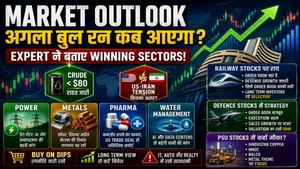 Share Market की तेज़ी बुरा फंसाएगी, बाज़ार में इन Stocks से बना लो दूरी!
 -
 Share Market में जोरदार तेजी, निफ्टी 24,200 के पार; सबसे अधिक किस शेयर में तेजी?
 -
 Trump Warning से Iran-US तनाव बढ़ा, Crude Oil में हलचल: Share Market Panic में क्या करें?
 -
 Share Market: कल की भारी गिरावट के बाद बाजार में लौटी तेजी, Sensex और Nifty में बढ़त के साथ कारोबार; आगे क्या
 -
 South Korea Market Crash: टेक शेयरों की बिकवाली से मचा हड़कंप! Bear Market में क्यों पहुंचा KOSPI?
 -
 Stock Market: शेयर बाजार में आज क्यों आई गिरावट? अमेरिका-ईरान तनाव के अलावा क्या है गिरावट की सबसे बड़ी वजहें
 -
 Sensex Outlook: सेंसेक्स 1 लाख तक पहुंचेगा या 66,000 तक गिरेगा? मॉर्गन स्टेनली ने बताए तीन बड़े अनुमान
 -
 Kalyan Jewellers Share Crash: अच्छे बिजनेस अपडेट के बावजूद 8% क्यों टूटा शेयर? जानिए पूरी वजह
 -
 Stock Market: अचानक क्यों टूटा बाज़ार? Sensex 350 प्वाइंट तो Nifty 24,450 के नीचे! जानिए 4 बड़ी वजहें
 -
 Stock Market Today: सप्ताह के पहले दिन शेयर बाजार में तेजी! आज शेयर बाजार में किसका रहा जलवा?
 -
 Stock Market में आएगा बड़ा ब्रेकआउट? 2026 के 5 सबसे दमदार सेक्टर्स!
 -
 HCL Tech Share Price: AI Deal के दम पर शेयर में 7% की तेजी, क्या आगे भी बढ़ेगा?
 -
 Share Market Today: सेंसेक्स 650 अंक उछला, निवेशकों की दौलत ₹2.43 लाख करोड़ बढ़ी, जानें तेजी की वजह
 -
 Nifty IT में 4% की तूफानी रैली! Infosys, TCS, Wipro में खरीदारी का मौका?
 -
 Vedanta Demerger के बाद धमाका: Oil & Gas में 20% की तेजी, निवेशकों की हुई चांदी
 -
 Nifty Outlook: क्या खत्म होगी गिरावट? 10 साल का Data क्या कहता है, जानें आगे की चाल
-
Block for 8 hours
-
Block for 12 hours
-
Block for 24 hours
-
Don't block

 Sign in with Google
- Male
- Female
- Others
- Under 18
- 18 to 25
- 26 to 35
- 36 to 45
- 45 to 55
- 55+