
 A Oneindia Venture


 Click it and Unblock the Notifications
Indiabulls Enterprises Ltd. के अकाउंट के लिये नोट
Mar 31, 2025
3.10. Provisions, Contingent Liabilities and Contingent Assets
Provisions are recognized only when there is a present obligation, as a result of past events, and when a reliable estimate of
the amount of obligation can be made at the reporting date. These estimates are reviewed at each reporting date and adjusted
to reflect the current best estimates. Provisions are discounted to their present values, where the time value of money is
material.
Led product warranties: The Company gave warranties on certain products and services, undertaking to repair / replace
products, which fail to perform satisfactorily during the warranty period. Provision made against warranties represents the
amount of the expected cost of meeting such obligation on account of repair / replacement. The timing of outflows is expected
to be within a period of two years from the date of balance sheet. Led lighting sales are reported as discontinued operations.
Contingent liability is disclosed for:
A disclosure for contingent liabilities is made where there is a possible obligation or a present obligation that may probably not
require an outflow of resources. When there is a possible or a present obligation where the likelihood of outflow of resources
is remote, no provision or disclosure is made.
Contingent assets are neither recognized nor disclosed. However, when realization of income is virtually certain, related asset
is recognized.
3.11. Discontinued operations and non-current assets held for sale
Discontinued operation is a component of the Company that has been disposed of or classified as held for sale and represents
a major line of business.
Non-current assets are classified as held for sale if it is highly probable that they will be recovered primarily through sale rather
than through continuing use.
Such assets are generally measured at the lower of their carrying amount and fair value less cost to sell. Losses on initial
classification as held for sale and subsequent gains and losses on re-measurement are recognised in the Statement of Profit
and Loss.
Once classified as held for sale, property, plant and equipment and intangible assets are no longer depreciated or amortised.
3.12. Business Combination
Business Combination Common control business combination is accounted using the pooling of interest method where the
Company is transferee. Assets and liabilities of the combining entities are reflected at their carrying amounts and no new asset
or liability is recognised. Identity of reserves of the transferor company is preserved by reflecting them in the same form in the
company''s standalone financial statements in which they appeared in the financial statement of the transferor company. The
excess between the amount of consideration paid over the share capital of the transferor company is recognised as a negative
amount and the same is disclosed as capital reserve on business combination. The financial information in the standalone
financial statements in respect of prior periods is restated from the beginning of the preceding period in the standalone
financial statements if the business combination date is prior to that date. However, if business combination date is after that
date, the financial information in the standalone financial statements is restated from the date of business combination.
3.13. Recent accounting pronouncements
Ministry of Corporate Affairs ("MCA") notifies new standards or amendments to the existing standards under Companies (Indian
Accounting Standards) Rules as issued from time to time. During the year ended 31 March 2025, MCA notified new accounting
standard Ind AS 117- Insurance Contracts, which has no impact on the company''s standalone financial statements. Further the
MCA has made certain amendments to Ind AS 116- Leases, in particularly related to sale and lease back transactions, which
has an applicability from 1 April 2024, and has no significant impact on standalone financial statements.
The Authorized Share Capital of the Company stand modified from "K 10,00,000 divided into 1,00,000 equity shares of K 10/-
each" to "K 70,00,00,000/- divided into 34,00,00,000 equity shares of K 2 each and 20,00,000 Preference Shares of K 10 each
pursuant to the composite Scheme of Amalgamation and Arrangement, (the Scheme) which came into effect on August 3,
2022.
a) Securities premium
The amount received in excess of face value of the equity shares is recognised in Securities Premium. The reserve is utilised in
accordance with the specific provisions of the Companies Act, 2013.
b) Capital reserve
This represents the balance credited on demerger of infrastructure business from erstwhile holding company Yaari Digital
Integrated Services Ltd as per the approval of composite scheme of arrangement by Hon''ble NCLT w.e.f 01 August 2022. The
appointed date of the scheme is 01 April 2019.
c) General reserve
This balance represents the balance transferred from deferred employee compensation reserve under the cancellation of
company''s employees stock option scheme dated 15 July 2022 .
d) Retained earnings
Retained earnings are created from the profit/loss of the Company as adjusted for distributions to owners, dividend distribution
and transfers to other reserves etc.
Contingent liabilities (to the extent not provided for)
a) Bank guarantees: Performance Bank guarantees of R 0.69 crore (31 March 2024: R 1.07 crore) secured by fixed deposits.
b) Claims (including interest) against the Company not acknowledged as debts: R 107.08 crore (31 March 2024: R 20.58 crore).
c) The above legal claims against the Company are in the ordinary course of business. Management has evaluated the same and,
based on the facts and after due consideration of the legal aspects of each case, no amount has been provided in respect of
the claims made against the Company under these cases. The Company does not expect any liability to arise and believes that
these litigations /lawsuits and claims, individually or in aggregate, will not have any material adverse effect on its financial
position.
d) There are no contingent liabilities in respect of income-tax demands for which appeals have been filed as at 31 March 2025
and 31 March 2024.
Commitments
a) Estimated amount of Contracts remaining to be executed on capital account (net of advances) Nil (31 March 2024: Nil).
Note-33
Investment in subsidiaries
a) These financial statements are separate financial statements prepared in accordance with Ind AS-27 " Separate Financial
Statements".
b) The Company ''s investments in subsidiaries are as under:
(i) Valuation principles
Fair value is the price that would be received to sell an asset or paid to transfer a liability in an orderly transaction, in the
principal (or most advantageous) market at the measurement date under current market conditions (i.e. an exit price)
regardless of whether that price is directly observable or estimated using a valuation technique. In order to show how fair
values have been derived, financial instruments are classified based on a hierarchy of valuation techniques.
(ii) Valuation governance
The Company''s fair value methodology and the governance over its models includes a number of controls and other
procedures to ensure appropriate safeguards are in place to ensure its quality and adequacy. All new product, initiatives
(including their valuation methodologies) are subject to approvals by various functions of the Company including the risk
and finance functions. The responsibility of ongoing measurement resides with the business units.
(iii) Fair value hierarchy :
Financial assets and financial liabilities measured at fair value in the statement of financial position are grouped into
three Levels of a fair value hierarchy. The three levels are defined based on the observability of significant inputs to the
measurement, as follows:
Level 1: quoted prices (unadjusted) in active markets for financial instruments.
Level 2: The fair value of financial instruments that are not traded in an active market is determined using valuation
techniques which maximise the use of observable market data rely as little as possible on entity specific estimates.
Level 3: If one or more of the significant inputs is not based on observable market data, the instrument is included in level
3.
For financials assets and financials liabilities which are measured at fair value as at the Balance Sheet date, the classification
of fair value calculations by category is summarised below:
Investment in equity instruments of subsidiaries are stated at cost or in accordance with IND-AS 109 as per Ind AS 27
''Separate Standalone financial statements''.
* These financial assets are mandatorily measured at fair value.
The management has assessed that the carrying value of financial assets and financial liabilities measured at amortised
costs (cash and cash equivalents, other bank balances, trade receivables, other financial assets, borrowings, trade
payables and other financial liabilities including lease liabilities) represents the best estimate of fair value largely due to
the short term nature of these instruments.
ii) Income, Expenses, Gains or Losses on Financial Instruments
Interest income and expenses, gains or losses recognised on financial assets and liabilities in the Statement of Profit and
Loss are as follows:
The Company''s financial risk management is an integral part of how to plan and execute its business strategies. The Company''s risk
management policy is set by the Board to achieve robust risk management framework to identify, monitor, mitigate and minimise
risks arising from financial instruments. The Company primary focus is to foresee the unpredictability of financial markets and seek
to minimise the potential adverse effects on its financial performance. A summary of the risks have been given below:
The Company''s principal financial liabilities comprise of borrowings, trade and other financial liabilities. The main purpose of these
financial liabilities is to finance the Company''s operations. The Company''s principal financial assets include loans, trade receivables,
investments, cash and cash equivalents, other bank balances and other financial assets that arise directly from its operations.
The Company''s activities expose it to market risk, liquidity risk and credit risk.
A Credit risk:
Credit risk is the risk that the counterparty will not meet its obligations under a financial instrument or customer contract,
leading to a financial loss. The Company is exposed to credit risk from its operating activities (primarily trade receivables)
including deposits placed with banks and financial institutions and other financial instruments.
Financial assets other than trade receivables
Credit risk from balances with banks and financial institutions is managed by the Company''s treasury department in accordance
with it''s policy. Surplus funds are parked only within approved investment categories with well defined limits. Investment
category is periodically reviewed by the Company''s Board of Directors.
Credit risk arising from short-term liquid funds, other balances with banks and other cash equivalents is limited and no
collaterals are held against these because the counterparties are banks and recognised financial institutions with high
credit ratings assigned by the credit rating agencies. None of the financial instruments of the Company result in material
concentration of credit risks
Allowance for expected credit losses
The Company provides for 12 month expected credit losses for following financial assets:-
Customer credit risk is managed as per the Company''s established policy, procedures and control relating to customer credit
risk management. Credit quality of a customer is assessed based on an extensive credit rating scorecard and individual
credit limits are defined in accordance with this assessment. Outstanding customer receivables are regularly monitored. The
requirement for impairment is analysed at each reporting date on an individual basis for major customers. The management
is also monitoring the receivables levels by having frequent interactions with responsible persons for highlighting potential
instances where receivables might become overdue.
Trade receivables consist of a large number of customers spread across India with no significant concentration of credit risk.
Ongoing credit evaluation is performed on the financial condition of accounts receivable. Therefore, the Company does not
expect any material risk on account of non-performance by any of its counterparties.
Expected credit loss for trade receivables under simplified approach
As per simplified approach, the Company makes provision of expected credit losses on trade receivables using a provision
matrix to mitigate the risk of default in payments and makes appropriate provision at each reporting date wherever outstanding
is for longer period and involves higher risk.
Market risk is the risk of loss of future earnings, fair values or future cash flows that may result from a change in the price of a
financial instrument. The value of a financial instrument may change as a result of changes in the interest rates, foreign currency
exchange rates, commodity prices, equity prices and other market changes that affect market risk sensitive instruments.
(i) Interest rate risk:
Interest rate risk is the risk that the fair value or future cash flows of a financial instrument will fluctuate because of
changes in prevailing market interest rates. Equipment loans are on fixed rate basis and hence not subject to interest rate
risk. Further term loan from others are also on fixed rate basis and hence not subject to interest risk.
Interest Rate Exposure:
(ii) Equity price risk:
The Company is not exposed to equity price risk arising from Equity Investments (other than Subsidiary, carried at cost).
(iii) Foreign exchange risk:
Foreign currency risk is the risk of impact related to fair value or future cash flows of an exposure in foreign currency,
which fluctuate due to changes in foreign exchange rates. The Company''s exposure to the risk of changes in foreign
exchange rates relates primarily to the capital expenditure and spares parts.
When a derivative is entered into for the purpose of being a hedge, the Company negotiates the terms of those derivatives
to match the terms of the hedged exposure.
The Company evaluates exchange rate exposure arising from foreign currency transactions. The Company follows
established risk management policies and standard operating procedures. It uses derivative instruments like forwards to
hedge exposure to foreign currency risk.
The Company''s objectives when managing capital are to (a) maximise shareholder value and provide benefits to other stakeholders
and (b) maintain an optimal capital structure to reduce the cost of capital. For the purposes of the Company''s capital management,
capital includes issued capital, share premium and all other equity reserves attributable to the equity holders.
''The Company monitors the capital structure on the basis of net debt to equity ratio and maturity profile of the overall debt
portfolio of the Company.
Net debt includes interest bearing borrowings less cash and cash equivalents, other bank balances (including non-current earmarked
balances) and current investments.
The table below summarises the capital, net debt and net debt to equity ratio of the Company.
M a4- rJnUf amiitw nafin
Note - 41
The sitting fees paid to non-executive directors is R 0.08 crore (31 March 2024: R 0.13 crore).
Note-42
Financial performance related to discontinued operations
In the financial year 2022-23, the Company has discontinued its business operation of LED Lighting. Consequently, LED Lighting''s
operations have been recognised as discontinued operations and related comparatives have been restated in accordance with the
requirement of Ind AS-105.
The financial performance of discontinued operation LED segment for the year are presented below.
No proceedings have been initiated or pending against the entity under the Benami Transactions (Prohibitions) Act, 1988 for the
year ended 31 March 2025 and 31 March 2024. Further, there is no such income which has not been disclosed in the books of
accounts. No such income is surrendered or disclosed as income for the year ended 31 March 2025 and 31 March 2024 in the tax
assessments under Income Tax Act, 1961.
As per the Ministry of Corporate Affairs (MCA) notification, proviso to Rule 3(1) of the Companies (Accounts) Rules, 2014, for the
financial year commencing 01 April 2024, every company which uses accounting software for maintaining its books of account,
shall use only such accounting software which has a feature of recording audit trail of each and every transaction, creating an edit
log of each change made in the books of account along with the date when such changes were made and ensuring that the audit
trail cannot be disabled. The interpretation and guidance on what level edit log and audit trail needs to be maintained evolved
during the year and continues to evolve.
The Company has used an accounting software for maintaining its books of account for the year, which has feature of recording
audit trail (edit log) facility at application level as well as database level and the same has operated throughout the year for all
relevant transactions recorded in the software. Further, the recording of audit trail (edit logs) can be disabled using restricted
privileged rights for direct data changes at database level, only by the developer. Since the company has other necessary controls
in place, which are operating effectively, this feature will not adversely impact its data and audit log retention directly at database
level.
Furthermore, the audit trail has been preserved by the Company as per the statutory requirements for record retention.
Nnte-45
*The improvement is primarily due to a reduction in losses compared to the previous year.
**The variance is due to lower losses, primarily from other income and reduced losses on asset disposals or write-offs.
#The increase is attributed to lower average trade receivables during the year, driven by improved collection from debtors.
##The increase is due to a decrease in average trade payables, resulting from timely settlement of outstanding dues.
@The ratio increased significantly due to a substantial reduction in working capital, driven by provisioning against financial assets
during the year.
$The improvement is mainly due to other income earned during the year and reduced losses from disposal or write-off of property,
plant, and equipment.
AThe variance is due to a decrease in other financial assets during the current year compared to the previous year.
Note-47
Wilful Defaulter:
No bank or financial institution has declared the company as "Wilful defaulter" for the year ended 31 March 2025 and 31 March
2024.
Relationship with Struck off Companies:
No transaction has been made with the company struck off under section 248 of the Companies Act, 2013 or section 560 of
Companies Act, 1956 for the year ended 31 March 2025 and 31 March 2024.
Note-50
Registration of charges or satisfaction with Registrar of Companies:
Pursuant to the Composite Scheme of Arrangement sanctioned by Hon''ble NCLT Bench, Chandigarh vide Order dated August 01,
2022 all applicable cases in the name of erstwhile company Soril Infra Resources Limited were transferred to Indiabulls Enterprises
Limited (resulting company 1) . The shifting of these charges from erstwhile Soril Infra Resources Limited to the name of Indiabulls
Enterprises Limited had been requested to the Ministry of Corporate Affairs and the same is updated. Further after updation of
name, all applicable cases where registration of charges or satisfaction is required with Registrar of Companies have been done
except for the below cases which are under process.
The company has complied with the number of layers prescribed under clause (87) of section 2 of the Act read with Companies
(Restriction on number of Layers) Rules, 2017 and no layers of companies has been established beyond the limit prescribed as per
above said section / rules for the year ended 31 March 2025 and 31 March 2024.
Note-52
Business combination implementation details as per Ind AS 103:
a) Hon''ble National company Law Tribunal approved the scheme of arrangement on 3rd August,2022 with the appointed date
being 1st April,2019 approved a re-organization plan to be implemented through a composite Scheme of Arrangement, which
inter alia, provides for:
At Step 1
The merger of SORIL Infra Resources Limited (''SORIL), its subsidiary and certain other subsidiaries of Yaari Digital Integrated
Services Limited (''YDISL'') into Yaari Digital Integrated Services Limited;
Albasta Wholesale Services Limited ("Transferor Company 1"),
Sentia Properties Limited ("Transferor Company 2"),
Lucina Infrastructure Limited ("Transferor Company 3"),
Ashva Stud and Agricultural Farms Limited ("Transferor Company 4"),
Mahabala Infracon Private Limited ("Transferor Company 5"),
SORIL Infra Resources Limited ("Transferor Company 6"),
Store One Infra Resources Limited ("Transferor Company 7"),
At Step 2
The demerger of non-insurance businesses of merged YDISL into Indiabulls Enterprises Ltd, the equity shares of which will be
listed on NSE & BSE ("IEL"); and
At Step 3
The demerger of on-going pharmaceutical business undertaking of Indiabulls Pharmaceuticals Limited ("IB Pharma") into
Indiabulls Pharmacare Limited, wholly owned subsidiary of IEL.
With the compliance of the above steps IEL financials were restated from the appointed date i.e. 1st April,2019 as a common
control business combination using the pooling of interests method of the aforesaid entities.
b) i) The Authorized Share Capital of the Company, stand modified from R 10,00,000, divided into 1,00,000 equity shares of R
10/- each to R 70,00,00,000/- divided into 34,00,00,000 equity shares of R 2 each and 20,00,000 Preference Shares of R
10 each.
(ii) The Company has issued and allotted, an aggregate of 19,83,36,997 fully paid-up equity shares of R 2/- each, to the
eligible shareholders of Yaari Digital Integrated Services Limited and Indiabulls Pharmaceuticals Limited. These equity
shares were admitted for trading on stock exchanges w.e.f. December 27, 2022.
(iii) The entire pre-allotment equity shares of the Company (i.e. an aggregate of 1,00,000 equity shares of R 10/- each) held
by Yaari Digital Integrated Services Limited in dematerialized form under ISIN: INE059901012, stands reduced, cancelled,
and extinguished.
(iv) Pursuant to the Scheme, the shareholders of Yaari and SORIL got extra shares of Indiabulls Enterprises Limited, free of any
cost, in addition to the equity shares of Yaari. The shares of Indiabulls Enterprises Limited got listed on NSE and BSE and
with this, post effectiveness of the Scheme, they have shares of two listed entities.
C) Statement showing the details of net assets acquired on demerger of infrastructure solutions business into Indiabulls
Enterprises Limited from Yaari Digital Integrated Services Limited as on appointed date (01 April 2019).
a ) There are no dues payable under section 125 of Companies Act, 2013 as at 31 March 2025 and 31 March 2024.
b ) In respect of amounts as mentioned under Section 124 of the Companies Act, 2013, there were no dues required to be
credited to the Investor Education and Protection Fund as on 31 March 2025 and 31 March 2024.
c) In the opinion of the Board of Directors, all current assets and long term loans and advances appearing in the balance sheet
as at 31 March 2025 and 31 March 2024 have a value on realization in the ordinary course of the Company''s business at least
equal to the amount at which they are stated in the financial statements. In the opinion of the board of directors no provision
is required to be made against the recoverability of these balances.
d) Figures for the previous year have been regrouped/reclassified wherever necessary to confirm to the current year''s
presentation.
e) Current year and previous year figures have been rounded off to the nearest crore of rupees upto two decimal places. The
figure R 0.00 wherever stated represents value less than R 50,000/-.
For Agrawal Prakash & Co. For and on behalf of the Board of Directors of
Chartered Accountants Indiabulls Enterprises Limited
Firm''s Registration Number : 005975N
Vikas Aggarwal Sargam Kataria Vijay Kumar Agrawal
Partner Director Whole Time Director
Membership Number: 097848 [DIN : 07133394] [DIN : 08329352]
Place: Gurugram Deepak Chadda Saurabh Garg
Date: 26 April 2025 Company Secretary Chief Financial Officer
Mar 31, 2024
v Disclosure of Shareholding of Promoter/Promoter group CompanyDisclosure of Shareholding of Promoter/Promoter group company as at 31-03-2024 is as follows:
The promoter shareholding of the company post the composite Scheme of Amalgamation and Arrangement by and among various companies as Transferor Companies , Transferee / Demerging Companies, Resulting Companies including the Company as Resulting Company 1 and their respective shareholders and creditors under Sections 230 to 232 of the Companies Act, 2013, and other applicable provisions of the Act, read with the Companies (Compromises, Arrangements and Amalgamations) Rules, 2016 ("Scheme"), which was approved by the Hon''ble National Company Law Tribunal (NCLT) vide its order dated 1st August, 2022 which came into effect from August 3, 2022 is as below:
vi Rights, preferences and restrictions attached to equity shares
The Company has only one class of equity shares having par value of R 2 per share. Each holder of equity shares is entitled to receive dividends as declared from time to time and one vote per share.
In the event of liquidation of the Company, the holders of equity shares will be entitled to receive remaining assets of the Company, after distribution of all preferential amounts. The distribution will be in proportion to the number of equity shares held by the shareholders.
vii There are no shares allotted as fully paid-up by way of bonus shares or allotted as fully paid-up pursuant to contract without payment being received in cash, or bought back during the period of five years immediately preceding the reporting date.
The description of the nature and purpose of each reserve within equity is as follows:
The amount received in excess of face value of the equity shares is recognised in Securities Premium. The reserve is utilised in accordance with the specific provisions of the Companies Act, 2013.
This represents the balance credited on demerger of infrastructure business from erstwhile holding company Yaari Digital Integrated Services Ltd as per the approval of composite scheme of arrangement by Hon''ble NCLT w.e.f 01 August 2022. The appointed date of the scheme is 01 April 2019.
Retained earnings are created from the profit/loss of the Company, as adjusted for distributions to owners, dividend distribution and transfers to other reserves etc.
(ii) Miscellaneous expenses includes software charges, office expenses, printing and stationery, bank charges etc. and does not include any item of expenditure with a value of more than 1% of the revenue from operations or R 10,00,000, whichever is higher.
Exceptional item for the previous year ended 31 March 2023 includes impairment provision of:
(i) Rs. 366.00 crores relating to wholly owned subsidiaries namely Airmid Aviation Services Limited and Indiabulls Pharmacare Limited towards the loans given and investments made based on the overall assessment of recoverable value on the basis of values determined by the independent external valuers using cash flows projections of respective businesses/new businesses. (Refer Note: 6 & 7)
(ii) Revaluation of Rs. 9.06 crores towards diminution in the value of Plant & Machinery in property, plant and equipment of the Company ( Refer Note:4)
Contingent liabilities (to the extent not provided for)
a) Bank guarantees: Performance Bank guarantees of R 0.92 crore (31 March 2023: R 1.18 crore) secured by fixed deposits.
b) Claims (excluding interest) against the Company not acknowledged as debts: R 20.58 crore (31 March 2023: R 24.67 crore).
c) There are no contingent liabilities in respect of income-tax demands for which appeals have been filed as at 31 March 2024 and 31 March 2023.
d) The above legal claims against the Company are in the ordinary course of business. Management has evaluated the same and depending upon the facts and after due evaluation of legal aspects of each case, no amount has been provided in respect of the claims made against the Company under these cases. Company does not expect any liability and these litigations /lawsuits and claims may, individually or in aggregate, will not have any material adverse effect on the financial position of the Company.
Lease related disclosures as per Ind AS 116
The Company has leases for office spaces, warehouses and machine yards. With the exception of short-term leases and some of the leases of low-value underlying assets, each lease is reflected on the balance sheet as a right-of-use asset and a lease liability.
Each lease generally imposes a restriction that, unless there is a contractual right for the Company to sublease the asset to another party, the right-of-use asset can only be used by the Company. Some leases contain an option to extend the lease for a further term. The Company is prohibited from selling or pledging the underlying leased assets as security. Further, the Company is required to pay maintenance fees in accordance with the lease contracts.
Employee Benefits - Provident Fund, ESIC, Gratuity and Compensated Absences disclosures as per Ind AS 19 - Employee Benefits: (A) Post retirement defined contribution plan
Contributions are made to Government Provident Fund and Family Pension Fund, ESIC and other statutory funds which cover all eligible employees under applicable Acts. Both the employees and the Company make predetermined contributions to the Provident Fund and ESIC. The contributions are normally based on a certain proportion of the employee''s salary.
(B) Post retirement defined benefit obligation
The Company has the following defined benefit plans:
- Gratuity (unfunded)
- Compensated absences (unfunded)
Provision for unfunded Gratuity and Compensated Absences for all employees is based upon actuarial valuations carried
out at the end of every financial year. Major drivers in actuarial assumptions, typically, are years of service and employee compensation. Pursuant to the issuance of the Indian Accounting Standard (Ind AS) 19 on ''Employee Benefits'', obligation are actuarially determined using the ''Projected Unit Credit'' Method. Gains and losses on changes in actuarial assumptions are accounted for in the Statement of Profit and Loss.
vi) New Code on Social Security, 2020
Code on Social Security, 2020 (''Code'') has been notified in the Official Gazette of India on 29 September 2020, which could impact the contributions of the Company towards certain employment benefits. Effective date from which changes are applicable is yet to be notified and the rules are yet to be framed. Impact, if any, of change will be assessed and accounted for in the period of notification of relevant provisions.
Note - 36Segment Reporting A) General information
For management purposes, the Company is organised into business units based on the nature of the products and services and their differing risks and returns. The organisation structure and internal reporting system has two reportable segments, as follows:
i) Equipment renting services, and ii) Management and maintenance services
No operating segments have been aggregated to form the above reportable operating segments.
The Company operates solely in one geographic segment namely "Within India" and hence no separate information for geographic segment wise disclosure is required.
The accounting policies adopted for segment reporting are in line with the accounting policy of the Company with following additional policies for segment reporting.
The Chief Operating Decision Maker ("CODM") monitors the operating results of its business units separately for the purpose of making decisions about resource allocation and performance assessment. Segment performance is evaluated based on profit or loss and is measured consistently with profit or loss in the financial statements.
i) Revenue and Expenses have been identified to a segment on the basis of relationship to operating activities of the segment. Expenses which relate to enterprise as a whole and are not allocable to a segment on reasonable basis have been disclosed as "Unallocable".
ii) Segment Assets and Segment Liabilities represent Assets and Liabilities in respective segments. Investments, tax related assets and other assets and liabilities that cannot be allocated to a segment on a reasonable basis have been disclosed as "Unallocable".
With the approval of the composite scheme of arrangement by the Board of Directors of the Company on 3rd August, 2022 all the ESOP became ineffective. Further, the Board of Directors of erstwhile SORIL Infra Resources Limited had cancelled the ESOPS on 15 July 2022.
Note - 39Financial instruments-accounting classification and fair value measurement A Fair value measurements(i) Valuation principles
Fair value is the price that would be received to sell an asset or paid to transfer a liability in an orderly transaction, in the principal (or most advantageous) market at the measurement date under current market conditions (i.e. an exit price) regardless of whether that price is directly observable or estimated using a valuation technique. In order to show how fair values have been derived, financial instruments are classified based on a hierarchy of valuation techniques.
The Company''s fair value methodology and the governance over its models includes a number of controls and other procedures to ensure appropriate safeguards are in place to ensure its quality and adequacy. All new product, initiatives (including their valuation methodologies) are subject to approvals by various functions of the Company including the risk and finance functions. The responsibility of ongoing measurement resides with the business units.
The Company uses the hierarchy for determining and disclosing the fair value of financial instruments based on the input that is significant to the fair value measurement as a whole, as explained in Note no. 3.2
Investment in equity instruments of subsidiaries are stated at cost or in accordance with IND-AS 109 as per Ind AS 27 ''Separate Standalone financial statements''.
* These financial assets are mandatorily measured at fair value.
The management has assessed that the carrying value of financial assets and financial liabilities measured at amortised costs (cash and cash equivalents, other bank balances, trade receivables, other financial assets, borrowings, trade payables and other financial liabilities including lease liabilities) represents the best estimate of fair value largely due to the short term nature of these instruments.
Financial risk management objective and policies
The Company''s financial risk management is an integral part of how to plan and execute its business strategies. The Company''s risk management policy is set by the Board to achieve robust risk management framework to identify, monitor, mitigate and minimise risks arising from financial instruments. The Company primary focus is to foresee the unpredictability of financial markets and seek to minimise the potential adverse effects on its financial performance. A summary of the risks have been given below:
The Company''s principal financial liabilities comprise of borrowings, trade and other financial liabilities. The main purpose of these financial liabilities is to finance the Company''s operations. The Company''s principal financial assets include loans, trade receivables, investments, cash and cash equivalents, other bank balances and other financial assets that arise directly from its operations.
The Company''s activities expose it to market risk, liquidity risk and credit risk.
Credit risk is the risk that the counterparty will not meet its obligations under a financial instrument or customer contract, leading to a financial loss. The Company is exposed to credit risk from its operating activities (primarily trade receivables) including deposits placed with banks and financial institutions and other financial instruments.
Financial assets other than trade receivables
Credit risk from balances with banks and financial institutions is managed by the Company''s treasury department in accordance with it''s policy. Surplus funds are parked only within approved investment categories with well defined limits. Investment category is periodically reviewed by the Company''s Board of Directors.
Credit risk arising from short-term liquid funds, other balances with banks and other cash equivalents is limited and no collaterals are held against these because the counterparties are banks and recognised financial institutions with high credit ratings assigned by the credit rating agencies. None of the financial instruments of the Company result in material concentration of credit risks
Customer credit risk is managed as per the Company''s established policy, procedures and control relating to customer credit risk management. Credit quality of a customer is assessed based on an extensive credit rating scorecard and individual credit limits are defined in accordance with this assessment. Outstanding customer receivables are regularly monitored. The requirement for impairment is analysed at each reporting date on an individual basis for major customers. The management is also monitoring the receivables levels by having frequent interactions with responsible persons for highlighting potential instances where receivables might become overdue.
Trade receivables consist of a large number of customers spread across India with no significant concentration of credit risk. Ongoing credit evaluation is performed on the financial condition of accounts receivable. Therefore, the Company does not expect any material risk on account of non-performance by any of its counterparties.
Expected credit loss for trade receivables under simplified approach
As per simplified approach, the Company makes provision of expected credit losses on trade receivables using a provision matrix to mitigate the risk of default in payments and makes appropriate provision at each reporting date wherever outstanding is for longer period and involves higher risk.
The Company manages liquidity risk by maintaining sufficient cash and investment in mutual funds and loan given to fellow subsidiaries. Management regularly monitors the position of cash and cash equivalents vis-a-vis projections. Assessment of maturity profiles of financial assets and financial liabilities including debt financing plans and maintenance of Balance Sheet liquidity ratios are considered while reviewing the liquidity position.
Market risk is the risk of loss of future earnings, fair values or future cash flows that may result from a change in the price of a financial instrument. The value of a financial instrument may change as a result of changes in the interest rates, foreign currency exchange rates, commodity prices, equity prices and other market changes that affect market risk sensitive instruments.
Interest rate risk is the risk that the fair value or future cash flows of a financial instrument will fluctuate because of changes in prevailing market interest rates. Equipment loans are on fixed rate basis and hence not subject to interest rate risk. The cash credit facility is on floating rate basis.
The Company is not exposed to equity price risk arising from Equity Investments (other than Subsidiary, carried at cost).
Foreign currency risk is the risk of impact related to fair value or future cash flows of an exposure in foreign currency, which fluctuate due to changes in foreign exchange rates. The Company''s exposure to the risk of changes in foreign exchange rates relates primarily to the capital expenditure and spares parts.
When a derivative is entered into for the purpose of being a hedge, the Company negotiates the terms of those derivatives to match the terms of the hedged exposure.
The Company evaluates exchange rate exposure arising from foreign currency transactions. The Company follows established risk management policies and standard operating procedures. It uses derivative instruments like forwards to hedge exposure to foreign currency risk.
The Company''s objectives when managing capital are to (a) maximise shareholder value and provide benefits to other stakeholders and (b) maintain an optimal capital structure to reduce the cost of capital. For the purposes of the Company''s capital management, capital includes issued capital, share premium and all other equity reserves attributable to the equity holders.
The Company monitors the capital structure on the basis of net debt to equity ratio and maturity profile of the overall debt portfolio of the Company.
Net debt includes interest bearing borrowings less cash and cash equivalents, other bank balances (including non-current earmarked balances) and current investments.
The table below summarises the capital, net debt and net debt to equity ratio of the Company.
Financial performance related to discontinued operations
During the last financial year 2022-23, the Company has discontinued its business operation of LED Lighting. Consequently, LED Lighting''s operations have been recognised as discontinued operations and related comparatives have been restated in accordance with the requirement of Ind AS-105.
Details with respect to the Benami properties & Undisclosed Income
No proceedings have been initiated or pending against the entity under the Benami Transactions (Prohibitions) Act, 1988 for year ended 31 March 2024 and 31 March 2023. Further, there is no such income which has not been disclosed in the books of accounts. No such income is surrendered or disclosed as income during the year ended 31 March 2024 and 31 March 2023 in the tax assessments under Income Tax Act, 1961.
As per the Ministry of Corporate Affairs (MCA) notification, proviso to Rule 3(1) of the Companies (Accounts) Rules, 2014, for the financial year commencing 01 April 2023, every company which uses accounting software for maintaining its books of account, shall use only such accounting software which has a feature of recording audit trail of each and every transaction, creating an edit log of each change made in the books of account along with the date when such changes were made and ensuring that the audit trail cannot be disabled. The interpretation and guidance on what level edit log and audit trail needs to be maintained evolved during the year and continues to evolve.
During the current year, the audit trail (edit logs) feature for any direct changes made at the database level was not enabled for the accounting softwares used for maintenance of books of account. However, the audit trail (edit log) at the application level for the accounting softwares was operating for all relevant transactions recorded in the softwares. "
Relationship with Struck off Companies:
No transaction has been made with the company struck off under section 248 of the Companies Act, 2013 or section 560 of Companies Act, 1956 during the year ended 31 March 2024 and 31 March 2023.
Note-51Registration of charges or satisfaction with Registrar of Companies:
Pursuant to the Composite Scheme of Arrangement sanctioned by Hon''ble NCLT Bench, Chandigargh vide Order dated August 01, 2022 all applicable cases in the name of erstwhile company Soril Infra Resources Limited were transferred to Indiabulls Enterprises Limited (resulting company 1) . The shifting of these charges from erstwhile Soril Infra Resources Limited to the name of Indiabulls Enterprises Limited has been requested to the Ministry of Corporate Affairs and the same is in the updation process.
Hence, due to non- updating of charge in the name of Company, these borrowings which have been closed and charge required to satisfy on MCA could not have been closed.
Note-52Compliance with number of layers of companies:
The company has complied with the number of layers prescribed under clause (87) of section 2 of the Act read with Companies (Restriction on number of Layers) Rules, 2017 and no layers of companies has been established beyond the limit prescribed as per above said section / rules, during the year ended 31 March 2024 and 31 March 2023.
Note-53Business combination implementation details as per Ind AS 103:
a) Hon''ble National company Law Tribunal approved the scheme of arrangement on 3rd August,2022 with the appointed date being 1st April,2019 approved a re-organization plan to be implemented through a composite Scheme of Arrangement, which inter alia, provides for:
The merger of SORIL Infra Resources Limited (''SORIL), its subsidiary and certain other subsidiaries of Yaari Digital Integrated Services Limited (''YDISL'') into Yaari Digital Integrated Services Limited;
Albasta Wholesale Services Limited (Transferor Company 1),
Sentia Properties Limited (Transferor Company 2),
Lucina Infrastructure Limited (Transferor Company 3),
Ashva Stud and Agricultural Farms Limited (Transferor Company 4),
Mahabala Infracon Private Limited (Transferor Company 5),
SORIL Infra Resources Limited (Transferor Company 6),
Store One Infra Resources Limited (Transferor Company 7),
The demerger of non-insurance businesses of merged YDISL into Indiabulls Enterprises Ltd, the equity shares of which will be listed on NSE & BSE (IEL); and
The demerger of on-going pharmaceutical business undertaking of Indiabulls Pharmaceuticals Limited (IB Pharma) into Indiabulls Pharmacare Limited, wholly owned subsidiary of IEL.
With the compliance of the above steps IEL financials were restated from the appointed date i.e. 1st April,2019 as a common control business combination using the pooling of interests method of the aforesaid entities.
b) i) The Authorized Share Capital of the Company, stand modified from Rs. 10,00,000, divided into 1,00,000 equity shares of Rs. 10/- each to Rs 70,00,00,000/- divided into 34,00,00,000 equity shares of Rs 2 each and 20,00,000 Preference Shares of Rs 10 each.
(ii) The Company has issued and allotted, an aggregate of 19,83,36,997 fully paid-up equity shares of Rs. 2/- each, to the eligible shareholders of Yaari Digital Integrated Services Limited and Indiabulls Pharmaceuticals Limited. These equity shares were admitted for trading on stock exchanges w.e.f. December 27, 2022.
(iii) The entire pre-allotment equity shares of the Company (i.e. an aggregate of 1,00,000 equity shares of Rs. 10/- each) held by Yaari Digital Integrated Services Limited in dematerialized form under ISIN: INE059901012, stands reduced, cancelled, and extinguished.
(iv) Pursuant to the Scheme, the shareholders of Yaari and SORIL got extra shares of Indiabulls Enterprises Limited, free of any cost, in addition to the equity shares of Yaari. The shares of Indiabulls Enterprises Limited got listed on NSE and BSE and with this, post effectiveness of the Scheme, they have shares of two listed entities.
C) Statement showing the details of net assets acquired on demerger of infrastructure solutions business into Indiabulls
Enterprises Limited from Yaari Digital Integrated Services Limited as on appointed date (01 April 2019).
a) These Standalone Financial Results include the corresponding figures of the Company for the year ended 31 March 2023 have been prepared, based on the published audited figures of the Company and the figures of the Company''s erstwhile holding companies, fellow subsidiaries and subsidiaries furnished by the management as adjusted for giving effect to Scheme as approved by the NCLT vide order dated July 21, 2022 which came into effect from August 3, 2022..
b) Subsequent the quarter, the Company has leased out on dry basis its certain Property Plant and Equipment to its wholly owned subsidiary company namely Airmid Aviation Services Limited (AASL) on requirement basis in order to establish AASL''s business of Equipment Hiring.
c ) There are no dues payable under section 125 of Companies Act, 2013 as at 31 March 2024 and 31 March 2023.
d ) In respect of amounts as mentioned under Section 124 of the Companies Act, 2013, there were no dues required to be credited to the Investor Education and Protection Fund as on 31 March 2024 and 31 March 2023.
e) In the opinion of the Board of Directors, all current assets and long term loans and advances, appearing in the balance sheet as at 31 March 2024 and 31 March 2023 have a value on realization, in the ordinary course of the Company''s business, at least equal to the amount at which they are stated in the financial statements. In the opinion of the board of directors, no provision is required to be made against the recoverability of these balances.
f) Figures for the previous year have been regrouped/reclassified wherever necessary to conform to the current year''s presentation.
g) Current year and previous year figures have been rounded off to the nearest crore of rupees upto two decimal places. The figure R 0.00 wherever stated represents value less than R 50,000/-.
Mar 31, 2023
The Authorized Share Capital of the Company, stand modified from "Rs. 10,00,000, divided into 1,00,000 equity shares of Rs. 10/- each" to "Rs 70,00,00,000/- divided into 34,00,00,000 equity shares of Rs 2 each and 20,00,000 Preference Shares of Rs 10 each pursuant to the composite Scheme of Amalgamation and Arrangement which came into effect on August 3, 2022 (the Scheme)
On 09 September 2022, the Company has allotted an aggregate of 198336997 fully paid-up equity shares of Rs 2/-each, pursuant to the composite Scheme of Amalgamation and Arrangement which came into effect on August 3, 2022 (the Scheme). The appointed date of the scheme is 01 April 2019.
Disclosure of Shareholding of Promoter/Promoter group company as at 31-03-2023 is as follows:
The promoter shareholding of the company post the composite Scheme of Amalgamation and Arrangement by and among various companies as Transferor Companies , Transferee / Demerging Companies, Resulting Companies including the Company as Resulting Company 1 and their respective shareholders and creditors under Sections 230 to 232 of the Companies Act, 2013, and other applicable provisions of the Act, read with the Companies (Compromises, Arrangements and Amalgamations) Rules, 2016 ("Scheme"), which was approved by the Hon''ble National Company Law Tribunal (NCLT) vide its order dated 1st August, 2022 which came into effect from August 3, 2022 is as below:
Previous figures of promoter holding not being given as the financials were restated from the appointed date of 1st April,2019.
vi Rights, preferences and restrictions attached to equity shares
The Company has only one class of equity shares having par value of ^ 2 per share. Each holder of equity shares is entitled to receive dividends as declared from time to time and one vote per share.
In the event of liquidation of the Company, the holders of equity shares will be entitled to receive remaining assets of the Company, after distribution of all preferential amounts. The distribution will be in proportion to the number of equity shares held by the shareholders.
vii There are no shares allotted as fully paid-up by way of bonus shares or allotted as fully paid-up pursuant to contract without payment being received in cash, or bought back during the period of five years immediately preceding the reporting date.
viii There are no securities issued by the company which are convertible into equity shares.
The description of the nature and purpose of each reserve within equity is as follows:
a) Securities premium
The amount received in excess of face value of the equity shares is recognised in Securities Premium. The reserve is utilised in accordance with the specific provisions of the Companies Act, 2013.
b) Deferred employee compensation reserve
The reserve is used to recognize the expenses related to stock options issued to employees under the Company''s employee stock option scheme. The balance standing in the credit of this reserve has been reversed pursuant to cancellation of Employees stock option schemes dated 15 July 2022 and has been credited to General Reserve. For details refer note 39.
c) Retained earnings
Retained earnings are created from the profit/loss of the Company, as adjusted for distributions to owners, dividend distribution and transfers to other reserves etc.
d) Capital Reserve
This represents the balance credited on demerger of infrastructure business from erstwhile holding company Yaari Digital Integrated Services Ltd as per the approval of composite scheme of arrangement by Hon''ble NCLT w.e.f 01 August 2022.
NOTES FORMING PART OF THE STANDALONE FINANCIAL STATEMENTS FOR THE YEAR ENDED 31 MARCH 2023
(ii) Details of Corporate social responsibility expenses
The Company through its implementing agency "Indiabulls Foundation" has initiated "Promotion of Education including scholarship to students" in various states of India.
(a) The gross amount required to be spent by the Company under Section 135 of the Companies Act, 2013 for the period ended is nil (31 March 2022: R 0.11 crore) i.e. 2% of average net profits for last three financial years, calculated as per Section 198 of the Companies Act, 2013.
(b) No amount has been spent on construction/acquisition of any assets by the Company.
(c) Payment during the period ended 31 March 2023 : Nil (31 March 2022: R 0.11 crore).
(iii) Miscellaneous expenses includes software charges, office expenses, printing and stationery, bank charges etc. and does not include any item of expenditure with a value of more than 1% of the revenue from operations or R 10,00,000, whichever is higher.
(iv) The Company has made assignment of its assets of Rs. 222 crores to its wholly owned subsidiary namely Airmid Aviation Services Limited and the wholly owned subsidiary set off this asset against its liability and consequently assigned this asset to a third party.
Exceptional item for the year ended 31 March 2023 includes impairment provision of:
(i) Rs. 366.00 crores relating to wholly owned subsidiaries namely Airmid Aviation Services Limited and Indiabulls Pharmacare Limited towards the loans given and investments made based on the overall assessment of recoverable value on the basis of values determined by the independent external valuers using cash flows projections of respective businesses/new businesses. (Refer Note: 6 & 7)
(ii) Revaluation of Rs. 9.06 crores towards diminution in the value of Plant & Machinery in property, plant and equipment of the Company. (Refer Note:4)"
NOTE - 33COMMITMENTS AND CONTINGENCIES
Contingent liabilities (to the extent not provided for)
a) Bank guarantees: Performance Bank guarantees of ^ 1.18 crore (31 March 2022: ^ 1.18 crore).
b) Claims (excluding interest) against the Company not acknowledged as debts: ^ 24.67 crore (31 March 2022: ^ 26.21 crore).
c) There are no contingent liabilities in respect of income-tax demands for which appeals have been filed as at 31 March 2023 and 31 March 2022.
d) The above legal claims against the Company are in the ordinary course of business. Management has evaluated the same and depending upon the facts and after due evaluation of legal aspects of each case, no amount has been provided in respect of the claims made against the Company under these cases. Company does not expect any liability and these litigations /lawsuits and claims may, individually or in aggregate, will not have any material adverse effect on the financial position of the Company.
NOTE - 34INVESTMENT IN SUBSIDIARIES
a) These financial statement are separate financial statements prepared in accordance with Ind AS-27 " Separate Financial Statements".
LEASE RELATED DISCLOSURES AS PER IND AS 116
The Company has leases for office spaces, warehouses and machine yards. With the exception of short-term leases and some of the leases of low-value underlying assets, each lease is reflected on the balance sheet as a right-of-use asset and a lease liability.
Each lease generally imposes a restriction that, unless there is a contractual right for the Company to sublease the asset to another party, the right-of-use asset can only be used by the Company. Some leases contain an option to extend the lease for a further term. The Company is prohibited from selling or pledging the underlying leased assets as security. Further, the Company is required to pay maintenance fees in accordance with the lease contracts.
Employee Benefits - Provident Fund, ESIC, Gratuity and Compensated Absences disclosures as per Ind AS 19 - Employee Benefits:
(A) Post retirement defined contribution plan
Contributions are made to Government Provident Fund and Family Pension Fund, ESIC and other statutory funds which cover all eligible employees under applicable Acts. Both the employees and the Company make predetermined contributions to the Provident Fund and ESIC. The contributions are normally based on a certain proportion of the employee''s salary.
(B) Post retirement defined benefit obligation
The Company has the following defined benefit plans:
- Gratuity (unfunded)
- Compensated absences (unfunded)
Provision for unfunded Gratuity and Compensated Absences for all employees is based upon actuarial valuations carried out at the end of every financial year. Major drivers in actuarial assumptions, typically, are years of service and employee compensation. Pursuant to the issuance of the Indian Accounting Standard (Ind AS) 19 on ''Employee Benefits'', obligation are actuarially determined using the ''Projected Unit Credit'' Method. Gains and losses on changes in actuarial assumptions are accounted for in the Statement of Profit and Loss.
vi) New Code on Social Security, 2020
Code on Social Security, 2020 (''Code'') has been notified in the Official Gazette of India on 29 September 2020, which could impact the contributions of the Company towards certain employment benefits. Effective date from which changes are applicable is yet to be notified and the rules are yet to be framed. Impact, if any, of change will be assessed and accounted for in the period of notification of relevant provisions.
A) General information
For management purposes, the Company is organised into business units based on the nature of the products and services and their differing risks and returns. The organisation structure and internal reporting system has two reportable segments, as follows:
i) Equipment renting services, and ii) Management and maintenance services
No operating segments have been aggregated to form the above reportable operating segments.
The Company operates solely in one geographic segment namely "Within India" and hence no separate information for geographic segment wise disclosure is required.
The accounting policies adopted for segment reporting are in line with the accounting policy of the Company with following additional policies for segment reporting.
The Chief Operating Decision Maker ("CODM") monitors the operating results of its business units separately for the purpose of making decisions about resource allocation and performance assessment. Segment performance is evaluated based on profit or loss and is measured consistently with profit or loss in the financial statements.
i) Revenue and Expenses have been identified to a segment on the basis of relationship to operating activities of the segment. Expenses which relate to enterprise as a whole and are not allocable to a segment on reasonable basis have been disclosed as "Unallocable".
ii) Segment Assets and Segment Liabilities represent Assets and Liabilities in respective segments. Investments, tax related assets and other assets and liabilities that cannot be allocated to a segment on a reasonable basis have been disclosed as "Unallocable".
With the approval of the composite scheme of arrangement by the Board of Directors of the company on 3rd August, 2022 all the below mentioned ESOP became ineffective. Further, the Board of Directors of SORIL Infra Resources Limited had cancelled the ESOPS on 15 July 2022 and the costs and capital has been reversed.
NOTE - 40FINANCIAL INSTRUMENTS-ACCOUNTING CLASSIFICATION AND FAIR VALUE MEASUREMENT
A Fair value measurements
(i) Valuation principles
Fair value is the price that would be received to sell an asset or paid to transfer a liability in an orderly transaction, in the principal (or most advantageous) market at the measurement date under current market conditions (i.e. an exit price) regardless of whether that price is directly observable or estimated using a valuation technique. In order to show how fair values have been derived, financial instruments are classified based on a hierarchy of valuation techniques.
(ii) Valuation governance
The Company''s fair value methodology and the governance over its models includes a number of controls and other procedures to ensure appropriate safeguards are in place to ensure its quality and adequacy. All new product, initiatives (including their valuation methodologies) are subject to approvals by various functions of the Company including the risk and finance functions. The responsibility of ongoing measurement resides with the business units.
(iii) Fair value hierarchy :
The Company uses the hierarchy for determining and disclosing the fair value of financial instruments based on the input that is significant to the fair value measurement as a whole, as explained in Note no. 3.2
For financials assets and financials liabilities which are measured at fair value as at the Balance Sheet date, the classification of fair value calculations by category is summarised below:
Investment in equity instruments of subsidiaries are stated at cost or in accordance with IND-AS 109 as per Ind AS 27 ''Separate Standalone financial statements''.
* These financial assets are mandatorily measured at fair value.
The management has assessed that the carrying value of financial assets and financial liabilities measured at amortised costs (cash and cash equivalents, other bank balances, trade receivables, other financial assets, borrowings, trade payables and other financial liabilities including lease liabilities) represents the best estimate of fair value largely due to the short term nature of these instruments.
FINANCIAL RISK MANAGEMENT OBJECTIVE AND POLICIES
The Company''s financial risk management is an integral part of how to plan and execute its business strategies. The Company''s risk management policy is set by the Board to achieve robust risk management framework to identify, monitor, mitigate and minimise risks arising from financial instruments. The Company primary focus is to foresee the unpredictability of financial markets and seek to minimise the potential adverse effects on its financial performance. A summary of the risks have been given below:
The Company''s principal financial liabilities comprise of borrowings, trade and other financial liabilities. The main purpose of these financial liabilities is to finance the Company''s operations. The Company''s principal financial assets include loans, trade receivables, investments, cash and cash equivalents, other bank balances and other financial assets that arise directly from its operations.
The Company''s activities expose it to market risk, liquidity risk and credit risk.
A Credit risk:
Credit risk is the risk that the counterparty will not meet its obligations under a financial instrument or customer contract, leading to a financial loss. The Company is exposed to credit risk from its operating activities (primarily trade receivables) including deposits placed with banks and financial institutions and other financial instruments.
Financial assets other than trade receivables
Credit risk from balances with banks and financial institutions is managed by the Company''s treasury department in accordance with it''s policy. Surplus funds are parked only within approved investment categories with well defined limits. Investment category is periodically reviewed by the Company''s Board of Directors.
Credit risk arising from short-term liquid funds, other balances with banks and other cash equivalents is limited and no collaterals are held against these because the counterparties are banks and recognised financial institutions with high credit ratings assigned by the credit rating agencies. None of the financial instruments of the Company result in material concentration of credit risks
Trade receivables
Customer credit risk is managed as per the Company''s established policy, procedures and control relating to customer credit risk management. Credit quality of a customer is assessed based on an extensive credit rating scorecard and individual credit limits are defined in accordance with this assessment. Outstanding customer receivables are regularly monitored. The requirement for impairment is analysed at each reporting date on an individual basis for major customers. The management is also monitoring the receivables levels by having frequent interactions with responsible persons for highlighting potential instances where receivables might become overdue.
Trade receivables consist of a large number of customers spread across India with no significant concentration of credit risk. Ongoing credit evaluation is performed on the financial condition of accounts receivable. Therefore, the Company does not expect any material risk on account of non-performance by any of its counterparties.
Expected credit loss for trade receivables under simplified approach
As per simplified approach, the Company makes provision of expected credit losses on trade receivables using a provision matrix to mitigate the risk of default in payments and makes appropriate provision at each reporting date wherever outstanding is for longer period and involves higher risk.
B Liquidity risk
The Company manages liquidity risk by maintaining sufficient cash and investment in mutual funds and loan given to fellow subsidiaries. Management regularly monitors the position of cash and cash equivalents vis-a-vis projections. Assessment of maturity profiles of financial assets and financial liabilities including debt financing plans and maintenance of Balance Sheet liquidity ratios are considered while reviewing the liquidity position.
C Market risk
Market risk is the risk of loss of future earnings, fair values or future cash flows that may result from a change in the price of a financial instrument. The value of a financial instrument may change as a result of changes in the interest rates, foreign currency exchange rates, commodity prices, equity prices and other market changes that affect market risk sensitive instruments.
(i) Interest rate risk:
Interest rate risk is the risk that the fair value or future cash flows of a financial instrument will fluctuate because of changes in prevailing market interest rates. Equipment loans are on fixed rate basis and hence not subject to interest rate risk. The cash credit facility is on floating rate basis.
(ii) Equity price risk:
The Company is not exposed to equity price risk arising from Equity Investments (other than Subsidiary, carried at cost).
(iii) Foreign exchange risk:
Foreign currency risk is the risk of impact related to fair value or future cash flows of an exposure in foreign currency, which fluctuate due to changes in foreign exchange rates. The Company''s exposure to the risk of changes in foreign exchange rates relates primarily to the capital expenditure, LED Lighting and spares parts.
When a derivative is entered into for the purpose of being a hedge, the Company negotiates the terms of those derivatives to match the terms of the hedged exposure.
The Company evaluates exchange rate exposure arising from foreign currency transactions. The Company follows established risk management policies and standard operating procedures. It uses derivative instruments like forwards to hedge exposure to foreign currency risk.
D Risk due to outbreak of COVID-19 pandemic
The management has made an assessment of the Impact of COVID- 19 on the Company''s operations, financial performance and position as at end for the quarter and year ended 31 March 2022 and has concluded that the impact is primarily on the operational aspects of the businesses and has considered the possible impact in preparing the financial results including the recoverable value of its assets and its liquidity position based on internal and external information upto the date of the approval of these financial results. The management continues keeping the track of the economic condition.
The Company''s objectives when managing capital are to (a) maximise shareholder value and provide benefits to other stakeholders and (b) maintain an optimal capital structure to reduce the cost of capital. For the purposes of the Company''s capital management, capital includes issued capital, share premium and all other equity reserves attributable to the equity holders.
The Company monitors the capital structure on the basis of net debt to equity ratio and maturity profile of the overall debt portfolio of the Company.
Net debt includes interest bearing borrowings less cash and cash equivalents, other bank balances (including non-current earmarked balances) and current investments.
The table below summarises the capital, net debt and net debt to equity ratio of the Company.
During the period, the Company has discontinued its business operation of LED Lighting. Consequently, LED Lighting'' operations have been recognised as discontinued operations and related comparatives have been restated in accordanci with the requirement of Ind AS-105.
DETAILS WITH RESPECT TO THE BENAMI PROPERTIES
No proceedings have been initiated or pending against the entity under the Benami Transactions (Prohibitions) Act, 1988 for the year ended 31 March 2023 and 31 March 2022.
There is no such income which has not been disclosed in the books of accounts. No such income is surrendered or disclosed as income during the year ended 31 March 2023 and 31 March 2022 in the tax assessments under Income Tax Act, 1961.
RELATIONSHIP WITH STRUCK OFF COMPANIES:
No transaction has been made with the company struck off under section 248 of the Companies Act, 2013 or section 560 of Companies Act, 1956 during the year ended 31 March 2023 and 31 March 2022.
NOTE-52REGISTRATION OF CHARGES OR SATISFACTION WITH REGISTRAR OF COMPANIES:
All applicable cases where registration of charges or satisfaction is required with Registrar of Companies have been done. No registration or satisfaction is pending for the year ended 31 March 2023 and 31 March 2022.
NOTE-53COMPLIANCE WITH NUMBER OF LAYERS OF COMPANIES:
The company has complied with the number of layers prescribed under clause (87) of section 2 of the Act read with Companies (Restriction on number of Layers) Rules, 2017 and no layers of companies has been established beyond the limit prescribed as per above said section / rules, during the year ended 31 March 2023 and 31 March 2022.
NOTE-54BUSINESS COMBINATION IMPLEMENTATION DETAILS AS PER IND AS 103:
a) Hon''ble National company Law Tribunal approved the scheme of arrangement on 3rd August,2022 with the appointed date being 1st April,2019 approved a re-organization plan to be implemented through a composite Scheme of Arrangement, which inter alia, provides for:
At Step 1
The merger of SORIL Infra Resources Limited (''SORIL), its subsidiary and certain other subsidiaries of Yaari Digital Integrated Services Limited (''YDISL'') into Yaari Digital Integrated Services Limited;
Albasta Wholesale Services Limited ("Transferor Company 1"),
Sentia Properties Limited ("Transferor Company 2"),
Lucina Infrastructure Limited ("Transferor Company 3"),
Ashva Stud and Agricultural Farms Limited ("Transferor Company 4"),
Mahabala Infracon Private Limited ("Transferor Company 5"),
SORIL Infra Resources Limited ("Transferor Company 6"),
Store One Infra Resources Limited ("Transferor Company 7"),
At Step 2
The demerger of non-insurance businesses of merged YDISL into Indiabulls Enterprises Ltd, the equity shares of which will be listed on NSE & BSE ("IEL"); and
At Step 3
The demerger of on-going pharmaceutical business undertaking of Indiabulls Pharmaceuticals Limited ("IB Pharma") into Indiabulls Pharmacare Limited, wholly owned subsidiary of IEL.
With the compliance of the above steps IEL financials were restated from the appointed date i.e. 1st April,2019 as a
common control business combination using the pooling of interests method of the aforesaid entities.
b) (i) The Authorized Share Capital of the Company, stand modified from "Rs. 10,00,000, divided into 1,00,000 equity shares of Rs. 10/- each" to "Rs 70,00,00,000/- divided into 34,00,00,000 equity shares of Rs 2 each and 20,00,000 Preference Shares of Rs 10 each".
(ii) The Company has issued and allotted, an aggregate of 19,83,36,997 fully paid-up equity shares of Rs. 2/- each, to the eligible shareholders of Yaari Digital Integrated Services Limited and Indiabulls Pharmaceuticals Limited. These equity shares were admitted for trading on stock exchanges w.e.f. December 27, 2022.
(iii) The entire pre-allotment equity shares of the Company (i.e. an aggregate of 1,00,000 equity shares of Rs. 10/-each) held by Yaari Digital Integrated Services Limited in dematerialized form under ISIN: INE059901012, stands reduced, cancelled, and extinguished."
(iv) Pursuant to the Scheme, the shareholders of Yaari and SORIL got extra shares of Indiabulls Enterprises Limited, free of any cost, in addition to the equity shares of Yaari. The shares of Indiabulls Enterprises Limited got listed on NSE and BSE and with this, post effectiveness of the Scheme, they have shares of two listed entities.
a) These Standalone Financial Results include the corresponding figures of the Company for the year ended 31 March 2022 have been prepared, based on the published audited figures of the Company and the figures of the Company''s erstwhile holding companies, fellow subsidiaries and subsidiaries furnished by the management as adjusted for giving effect to Scheme as approved by the NCLT vide order dated July 21, 2022 which came into effect from August 3, 2022..
b) Subsequent the current quarter, the Company has leased out on dry basis its certain Property Plant and Equipment to its wholly owned subsidiary company namely Airmid Aviation Services Limited (AASL) on requirement basis in order to establish AASL''s business of Equipment Hiring.
c) There are no dues payable under section 125 of Companies Act, 2013 as at 31 March 2023 and 31 March 2022.
d) In respect of amounts as mentioned under Section 124 of the Companies Act, 2013, there were no dues required to be credited to the Investor Education and Protection Fund as on 31 March 2023 and 31 March 2022.
e) In the opinion of the Board of Directors, all current assets and long term loans and advances, appearing in the balance
sheet as at 31 March 2023 and 31 March 2022 have a value on realization, in the ordinary course of the Company''s
business, at least equal to the amount at which they are stated in the financial statements. In the opinion of the board of directors, no provision is required to be made against the recoverability of these balances.
f) Figures for the previous year have been regrouped/reclassified wherever necessary to conform to the current year''s presentation.
g) Current year and previous year figures have been rounded off to the nearest crore of rupees upto two decimal places. The figure ^ 0.00 wherever stated represents value less than ^ 50,000/-.
Disclaimer: This is 3rd Party content/feed, viewers are requested to use their discretion and conduct proper diligence before investing, GoodReturns does not take any liability on the genuineness and correctness of the information in this article
Indiabulls Enterprises Ltd. पर और जानकारी
-
Indiabulls Enterprises Ltd. टूल
- बल्क डील
-
Indiabulls Enterprises Ltd. कंपनी का विवरण
- कंपनी का प्रोफाइल
- कंपनी का इतिहास
- मैनेजमेंट टीम
- पूंजी ढांचा
- प्रॉडक्ट मिक्स
- बैंकर/ऑडीटर/रजिस्ट्रार
-
कंपनी का इतिहास
- बीएसई मूल्य इतिहास
- एनएसई मूल्य इतिहास
-
Indiabulls Enterprises Ltd. मुख्य वित्तीय अनुपात
- अनुपात
-
Indiabulls Enterprises Ltd. परिणाम
- तिमाही परिणाम
- छहमाही परिणाम
- नौ महीने के परिणम
- वार्षिक परिणाम
-
Indiabulls Enterprises Ltd. Financial Data
- ऑडिट के परिणाम
- नकदी प्रवाह
- बैलेंस शीट
-
Indiabulls Enterprises Ltd. की रिपोर्ट
- लेखा नीति
- ऑडीटर की रिपोर्ट
- निदेशक की रिपोर्ट
- खाते के लिये नोट
-
Indiabulls Enterprises Ltd. कॉर्पोरेट घोषणाएं
- बुक क्लोज़र
- बोर्ड की मीटिंग
-
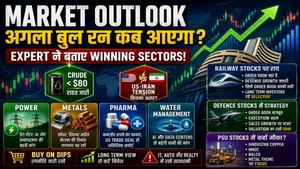 Share Market की तेज़ी बुरा फंसाएगी, बाज़ार में इन Stocks से बना लो दूरी!
 -
 Share Market में जोरदार तेजी, निफ्टी 24,200 के पार; सबसे अधिक किस शेयर में तेजी?
 -
 Trump Warning से Iran-US तनाव बढ़ा, Crude Oil में हलचल: Share Market Panic में क्या करें?
 -
 Share Market: कल की भारी गिरावट के बाद बाजार में लौटी तेजी, Sensex और Nifty में बढ़त के साथ कारोबार; आगे क्या
 -
 South Korea Market Crash: टेक शेयरों की बिकवाली से मचा हड़कंप! Bear Market में क्यों पहुंचा KOSPI?
 -
 Stock Market: शेयर बाजार में आज क्यों आई गिरावट? अमेरिका-ईरान तनाव के अलावा क्या है गिरावट की सबसे बड़ी वजहें
 -
 Sensex Outlook: सेंसेक्स 1 लाख तक पहुंचेगा या 66,000 तक गिरेगा? मॉर्गन स्टेनली ने बताए तीन बड़े अनुमान
 -
 Kalyan Jewellers Share Crash: अच्छे बिजनेस अपडेट के बावजूद 8% क्यों टूटा शेयर? जानिए पूरी वजह
 -
 Stock Market: अचानक क्यों टूटा बाज़ार? Sensex 350 प्वाइंट तो Nifty 24,450 के नीचे! जानिए 4 बड़ी वजहें
 -
 Stock Market Today: सप्ताह के पहले दिन शेयर बाजार में तेजी! आज शेयर बाजार में किसका रहा जलवा?
 -
 Stock Market में आएगा बड़ा ब्रेकआउट? 2026 के 5 सबसे दमदार सेक्टर्स!
 -
 HCL Tech Share Price: AI Deal के दम पर शेयर में 7% की तेजी, क्या आगे भी बढ़ेगा?
 -
 Share Market Today: सेंसेक्स 650 अंक उछला, निवेशकों की दौलत ₹2.43 लाख करोड़ बढ़ी, जानें तेजी की वजह
 -
 Nifty IT में 4% की तूफानी रैली! Infosys, TCS, Wipro में खरीदारी का मौका?
 -
 Vedanta Demerger के बाद धमाका: Oil & Gas में 20% की तेजी, निवेशकों की हुई चांदी
 -
 Nifty Outlook: क्या खत्म होगी गिरावट? 10 साल का Data क्या कहता है, जानें आगे की चाल
-
Block for 8 hours
-
Block for 12 hours
-
Block for 24 hours
-
Don't block

 Sign in with Google
- Male
- Female
- Others
- Under 18
- 18 to 25
- 26 to 35
- 36 to 45
- 45 to 55
- 55+