
 A Oneindia Venture


 Click it and Unblock the Notifications
Rockingdeals Circular Economy Ltd. कंपली की लेखा नीति
Mar 31, 2025
2. Summary of Significant accounting policies
a) Basis of Preparation of Financial Statements
These financial statements have been prepared to comply with the Generally Accepted Accounting
Principles in India (Indian GAAP), including the Accounting Standards notified under the relevant
provisions of the Companies Act, 2013. The financial statements have been prepared on an accrual
basis, under the historical cost convention and on the accounting principles of a going concern.
The accounting policies adopted in the preparation of financial statements are consistent with those of
previous year. The financial statements are presented in Indian rupees unless otherwise stated.
b) Use of estimates
The preparation of financial statements in conformity with Indian GAAP requires management to
make estimates and assumptions that affect the reported amount of assets, liabilities, revenues and
expenses and disclosure of contingent liabilities on the date of the financial statements. The
estimates and assumptions used in the accompanying financial statements are based upon
managementâs evaluation of the relevant facts and circumstances as of the date of financial
statements which in management''s opinion are prudent and reasonable. Actual results may differ
from the estimates used in preparing the accompanying financial statements. Any revision to
accounting estimates is recognised prospectively in current and future periods.
c) Property, Plant & Equipment
Tangible assets are stated at cost less accumulated depreciation. The total cost of assets
comprises its purchase price, freight, duties, taxes and any other incidental expenses
directly attributable to bringing the asset to the working condition for its intended use.
Intangible assets are recognized if it is probable that the future economic benefits
that are attributable to the assets will flow to the Company and cost of the assets can
be measured reliably.
d) Depreciation
Depreciation on Fixed Assets is provided to the extent of depreciable amount on the Written
Down value (WDV). Depreciation is provided based on useful life of the assets as prescribed in
Schedule II to the Companies Act, 2013
e) Inventories
The Company makes valuation of inventory on the basis of cost or net realizable value
whichever is lower.
f) Revenue Recognition
Revenue is recognized to the extent that it is probable that the economic benefits will flow to the
Company and the revenue can be reliably measured.
⢠Sales of goods
Revenue from sale of goods is recognised on transfer of all significant risks and rewards of
ownership to the buyer. Sales are stated net of trade discount, duties, sales tax and GST.
⢠Service Income
Service income is recognised as per the terms of the contract when the related services are
rendered. It is stated net of GST.
⢠Interest income
Interest income is recognized on time proportion basis.
g) Taxation
Income-tax expense comprises current tax, deferred tax charge or credit,
Current tax
Provision for current tax is made for the tax liability payable on taxable income after
considering tax allowances, deductions and exemptions determined in accordance with
the prevailing tax laws.
Deferred tax
Deferred tax liability or asset is recognized for timing differences between the
profits/losses offered for income tax and profits/losses as per the financial statements.
Deferred tax assets and liabilities are measured using the tax rates and tax laws that have
been enacted or substantively enacted at the Balance Sheet date.
Deferred tax asset is recognized only to the extent there is reasonable certainty that the assets can be realized
in future; however, where there is unabsorbed depreciation or carried forward loss under taxation laws,
deferred tax asset is recognized only if there is a virtual certainty of realization of such asset. Deferred tax
asset is reviewed as at each Balance Sheet date and written down or written up to reflect the amount that is
reasonably/virtually certain to be realized.
h) Earnings Per Share
Basic earnings per share is calculated by dividing the net profit or loss for the period attributable
to equity shareholders by the weighted average number of equity shares outstanding during the
period. Earnings considered in ascertaining the Companyâs earnings per share is the net profit for
the period after deducting preference dividends and any attributable tax thereto for the period.
The weighted average number of equity shares outstanding during the period and for all periods
presented is adjusted for events, such as bonus shares, other than the conversion of potential equity
shares that have changed the number of equity shares outstanding, without a corresponding
change in resources. For the purpose of calculating diluted earnings per share, the net profit or
loss for the period attributable to equity shareholders and the weighted average number of shares
outstanding during the period is adjusted for the effects of all dilutive potential equity shares.
Mar 31, 2024
Significant Accounting Policies 1. Corporate information
Rockingdeals Circular Economy Limited (Formerly knowns as Technix Electronics Limited), was incorporated on July 29, 2002, with the purpose of engaging in the trading of mobile phones, electronics, home appliances, apparels, and various household-related items.
The Company has converted from Private Limited Company to Public Limited Company, pursuant to a special resolution passed in the extraordinary general meeting of the shareholders of the Company held on April 20, 2023 and consequently the name of the Company has been changed to Technix Electronics Limited in a fresh certificate of incorporation obtained from the Registrar of Companies on July 10, 2023.
The Name of Company has been again changed to Rockingdeals Circular Economy Limited and fresh certificate of incorporation obtained from the Registrar of Companies on August 17, 2023.
Summary of Significant accounting policies
a) Basis of Preparation of Financial Statements
These financial statements have been prepared to comply with the Generally Accepted Accounting Principles in India (Indian GAAP), including the Accounting Standards notified under the relevant provisions of the Companies Act, 2013. The financial statements have been prepared on an accrual basis, under the historical cost convention and on the accounting principles of a going concern.
The accounting policies adopted in the preparation of financial statements are consistent with those of previous year. The financial statements are presented in Indian rupees, rounded off to the nearest lakh unless otherwise stated.
The preparation of financial statements in conformity with Indian GAAP requires management to make estimates and assumptions that affect the reported amount of assets, liabilities, revenues and expenses and disclosure of contingent liabilities on the date of the financial statements. The estimates and assumptions used in the accompanying financial statements are based upon managementâs evaluation of the relevant facts and circumstances as of the date of financial statements which in management''s opinion are prudent and reasonable. Actual results may differ
from the estimates used in preparing the accompanying financial statements. Any revision to accounting estimates is recognised prospectively in current and future periods.
c) Property, Plant & Equipment
Tangible assets are stated at cost less accumulated depreciation. The total cost of assets comprises its purchase price, freight, duties, taxes and any other incidental expenses directly attributable to bringing the asset to the working condition for its intended use.
Intangible assets are recognized if it is probable that the future economic benefits that are attributable to the assets will flow to the Company and cost of the assets can be measured reliably.
Depreciation on Fixed Assets is provided to the extent of depreciable amount on the Written Down value (WDV). Depreciation is provided based on useful life of the assets as prescribed in Schedule II to the Companies Act, 2013
The Company makes valuation of inventory on the basis of cost or net realizable value whichever is lower.
Revenue is recognized to the extent that it is probable that the economic benefits will flow to the Company and the revenue can be reliably measured.
⢠Sales of goods
Revenue from sale of goods is recognised on transfer of all significant risks and rewards of ownership to the buyer. Sales are stated net of trade discount, duties, sales tax and Goods and Service Tax ( GST).
⢠Service Income
Service income is recognised as per the terms of the contract when the related services are rendered. It is stated net of Goods and Service Tax ( GST).
⢠Interest income
Interest income is recognized on time proportion basis.
Income-tax expense comprises current tax, deferred tax charge or credit,
Current tax
Provision for current tax is made for the tax liability payable on taxable income after considering tax allowances, deductions and exemptions determined in accordance with the prevailing tax laws.
Deferred tax
Deferred tax liability or asset is recognized for timing differences between the profits/losses offered for income tax and profits/losses as per the financial statements. Deferred tax assets and liabilities are measured using the tax rates and tax laws that have been enacted or substantively enacted at the Balance Sheet date.
Deferred tax asset is recognized only to the extent there is reasonable certainty that the assets can be realized in future; however, where there is unabsorbed depreciation or carried forward loss under taxation laws, deferred tax asset is recognized only if there is a virtual certainty of realization of such asset. Deferred tax asset is reviewed as at each Balance Sheet date and written down or written up to reflect the amount that is reasonably/virtually certain to be realized.
Basic earnings per share are calculated by dividing the net profit or loss for the period attributable to equity shareholders by the weighted average number of equity shares outstanding during the period.
i) Provisions and Contingencies
A provision is recognized when an enterprise has a present obligation as a result of past event and it is probable that an outflow of resources will be required to settle the obligation, in respect of which a reliable estimate can be made. Provisions are not discounted to their present values and are determined based on management estimate required to settle the obligation at the Balance Sheet date. These are reviewed at each Balance Sheet date and adjusted to reflect the current management estimates.
Contingent liabilities are disclosed in respect of possible obligations that have arisen from past events and the existence of which will be confirmed only by the occurrence or non-occurrence of future events not wholly within the control of the Company.
When there is an obligation in respect of which the likelihood of outflow of resources is remote, no provision or disclosure is made.
Disclaimer: This is 3rd Party content/feed, viewers are requested to use their discretion and conduct proper diligence before investing, GoodReturns does not take any liability on the genuineness and correctness of the information in this article
Rockingdeals Circular Economy Ltd. पर और जानकारी
-
Rockingdeals Circular Economy Ltd. टूल
- बल्क डील
-
Rockingdeals Circular Economy Ltd. कंपनी का विवरण
- कंपनी का प्रोफाइल
- कंपनी का इतिहास
- मैनेजमेंट टीम
- पूंजी ढांचा
- प्रॉडक्ट मिक्स
- बैंकर/ऑडीटर/रजिस्ट्रार
-
कंपनी का इतिहास
- अधिकार
- एनएसई मूल्य इतिहास
-
Rockingdeals Circular Economy Ltd. मुख्य वित्तीय अनुपात
- अनुपात
-
Rockingdeals Circular Economy Ltd. परिणाम
- तिमाही परिणाम
- छहमाही परिणाम
- वार्षिक परिणाम
-
Rockingdeals Circular Economy Ltd. Financial Data
- ऑडिट के परिणाम
- नकदी प्रवाह
- बैलेंस शीट
-
Rockingdeals Circular Economy Ltd. की रिपोर्ट
- लेखा नीति
- ऑडीटर की रिपोर्ट
- निदेशक की रिपोर्ट
- खाते के लिये नोट
-
Rockingdeals Circular Economy Ltd. कॉर्पोरेट घोषणाएं
- बुक क्लोज़र
- बोर्ड की मीटिंग
-
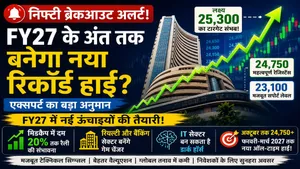 Share Market में नए Record High की तैयारी? Nifty, Midcap, Realty पर एक्सपर्ट का बड़ा दांव
 -
 Share Market: शेयर मार्केट में जोरदार तेजी! Nifty 24,100 के करीब, जानिए वजह
 -
 Meesho के शेयर में 6% से ज्यादा उछाल, Citi ने दी Buy रेटिंग, अब क्या करें निवेशक?
 -
 Share Market: शेयर बाजार में जोरदार गिरावट, निफ्टी ने 23,900 का लेवल तोड़ा, वजह जानकर हो जाएंगे हैरान
 -
 GRSE Share Price: नवरत्न स्टेटस के बाद शेयर में रॉकेट रैली, 5% उछाल; खरीदें या नहीं?
 -
 Kirloskar Oil Engines Ltd में तूफानी तेजी! डेटा सेंटर और AI में एंट्री से बना काम, 20% की तेज उछाल
 -
 Share Market में नई तेजी या करेक्शन? Jigar Patel के Top Stocks और Market Strategy!
 -
 Nifty IT Crash: Infosys, TCS समेत सभी शेयरों मे गिरवाट! Accenture की रिपोर्ट ने IT शेयरों को कैसे झटका दिया?
 -
 Nykaa में धमाका! शेयर 8% उछला, 1 साल के हाई पर पहुंचा स्टॉक, वजह क्या?
 -
 Share Market में लगी है सबसे बड़ी Discount Sale? 54% Share सस्ते, Experts क्या कह रहे?
 -
 Nifty Expiry के दिन तेजी का माहौल, लेकिन 24,000 के ऊपर टिक नहीं पाया बाज़ार
 -
 Stock Market Today: शेयर बाजार में अचानक क्यों आई इतनी बड़ी तेजी? रुपये की भी दमदार वापसी!
 -
 IT सेक्टर में हाहाकार, Anthropic के नए AI मॉडल ने मचाया तबाही! आखिर कब लौटेगी तेजी?
 -
 Nifty Target: विदेशी ब्रोकरेज ने घटाया निफ्टी का टारगेट, क्या बाजार पर मंडरा रहा है बड़ा खतरा?
 -
 Stock Market: सेंसेक्स 900 अंक टूटा, निफ्टी 250 अंक से ज्यादा लुढ़का! गिरावट के पीछे ये 5 बड़े कारण
 -
 Share Market Update: शेयर बाजार में आज भी Melody इफेक्ट बरकरार, सेंसेक्स-निफ्टी क्यों भाग रहे है?
-
Block for 8 hours
-
Block for 12 hours
-
Block for 24 hours
-
Don't block

 Sign in with Google
- Male
- Female
- Others
- Under 18
- 18 to 25
- 26 to 35
- 36 to 45
- 45 to 55
- 55+